
You want a curved screen that makes racing lines, open-world maps, and split-screen work feel less cramped without turning your desk into a cluttered command center. These six picks cover that ground from compact 32-inch 4K models to massive ultrawide and dual-4K panels, so you can match resolution, speed, and desk depth to the way you actually play and work.
The real split is simple, speed first, image quality first, or sheer width first. That’s why this roundup keeps the focus on panel type, refresh rate, curve radius, port selection, and the practical trade-offs that show up once the monitor sits in your space.
The Shortlist At A Glance

Alienware 34 Curved Gaming Monitor AW3425DWM 34-inch WQHD 180Hz 1ms Display 1500R AMD FreeSync Premium VESA AdaptiveSync

LG 45GX950A-B 45-inch Ultragear 5K2K WUHD OLED Curved Gaming Monitor Dual-Mode 165Hz 0.03ms NVIDIA G-Sync AMD FreeSync Premium Pro HDR True Black 400 USB Type-C 90W DP2.1

Samsung 57 Odyssey Neo G9 G95NC Dual 4K UHD 1000R Curved Gaming Monitor 240Hz 1ms with DisplayPort 2.1 Quantum Mini-LED DisplayHDR 1000 AMD FreeSync Premium Pro LS57CG952NNXZA

CRUA 32 4K UHD 160Hz Curved Gaming Monitor 1500R AMD FreeSync White 3840×2160 VA 120%sRGB Built-In Speakers HDMI 2.1 DP 1.4 and 75x75mm Wall Mount

Alienware 34 240Hz QD-OLED Curved Gaming Monitor AW3425DW 34.2-inch WQHD 0.03ms Display 1800R Curve AMD FreeSync Premium Pro VESA AdaptiveSync DisplayHDR TrueBlack 400
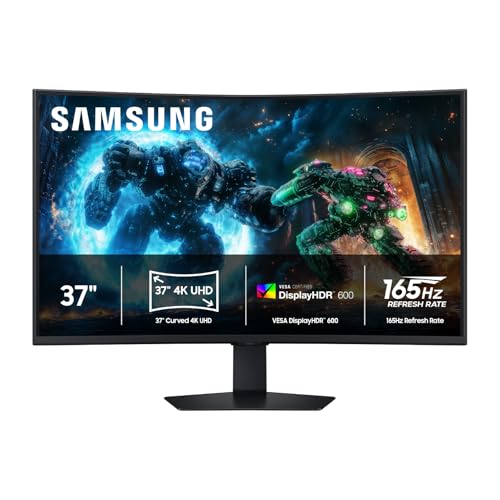
Samsung 37 Odyssey G7 G75F Series 4K UHD Curved Gaming Monitor 165Hz 1ms Response Time GtG VESA DisplayHDR 600 AMD FreeSync Premium Pro LS37FG75DENXZA
More Details On Our Top Picks
Alienware’s 34-inch ultrawide format makes sense for gaming desks that also handle work, because WQHD keeps the panel easier to drive than a full 4K ultrawide. The 1500R curve is moderate, so it wraps around your view without feeling extreme. In most setups, that lands in the sweet spot between immersion and desk practicality.
Refresh rate at 180Hz and a 1ms response spec point this one toward motion-heavy play, while AMD FreeSync Premium and VESA AdaptiveSync help with variable frame output. The honest trade-off is resolution, since you give up the extra pixel density that a 4K panel can deliver. You get a cleaner fit for mixed use, and that matters more than raw scale for many desks.
Strong Points
- 34-inch ultrawide shape gives room for timelines, side panels, and HUD-heavy games without feeling oversized.
- 180Hz refresh supports fluid motion in shooters, racers, and other fast titles.
- FreeSync Premium and VESA AdaptiveSync help smooth frame pacing with compatible hardware.
- 1500R curvature is gentle enough for general use, not just gaming.
Things To Consider
- WQHD is a step down from the sharper 4K class some shoppers want in this category.
- Ultrawide width needs more desk depth than a standard 32-inch screen.
- That curved panel can take a little more care during cleaning and placement.
Key Specs
Who It Suits Best
You get the most from this pick if you want a wide gaming view and still need a monitor that behaves well for daily desktop tasks.
A Better Fit Elsewhere
LG 45GX950A-B suits you better when a larger OLED canvas and dual-mode flexibility matter more than desk efficiency.
This LG goes big in a way that actually changes the desk experience, because 45 inches with a 5K2K panel gives you a lot of usable space for both games and side-by-side windows. OLED means each pixel lights itself, which is why contrast-heavy scenes usually look cleaner than on many backlit panels. The trade-off is simple, it asks for space, power, and a stronger graphics setup.
Dual-mode support adds flexibility, so you’re not locked into one style of use, and the 0.03ms response spec is aimed squarely at motion clarity. USB Type-C with 90W power delivery can reduce cable clutter for laptop setups, while DisplayPort 2.1 helps on the connectivity side. It’s a serious upgrade path for hybrid workstations, although not the pick for cramped desks.
What We Like
- Large 45-inch panel gives you room for immersive gaming and productive multitasking.
- 5K2K resolution keeps text and interface elements very detailed across a wide canvas.
- OLED panel structure supports deep contrast and strong dark-scene separation.
- USB Type-C with 90W output can simplify a laptop docking setup.
- Dual-mode design gives you more flexibility around gaming and general desktop use.
Points To Note
- The footprint is large, so shallow desks can feel crowded fast.
- OLED owners often pay extra attention to static interface elements during long desktop sessions.
- High-end display hardware makes this a less casual choice than the Alienware 34 AW3425DWM.
Feature Rundown
Who Should Grab It
You’ll like this most if your setup doubles as a gaming station and a serious work desk, with enough space to handle a large screen.
Where A Sibling Pick Shines
Alienware 34 Curved Gaming Monitor AW3425DWM is the easier fit for smaller desks and for you if wide format matters more than sheer size.
Samsung’s 57-inch dual-4K layout is less a monitor and more a wall of workspace, which is exactly why sim racers, flight sim fans, and multitaskers keep looking at it. The 1000R curve is aggressive, so the panel wraps tightly around your field of view. That shape is immersive, though it also means you need a very deep desk and a setup that can physically accommodate it.
Mini-LED backlighting brings more precise zone control than basic edge-lit screens, and DisplayHDR 1000 signals a brighter HDR target than the budget class. At 240Hz with 1ms response, it has the speed to match the size, which is rare at this scale. The practical catch is obvious, this much screen can overpower a small room and puts more pressure on your GPU than the previous picks.
Upsides
- 57-inch size creates an enormous uninterrupted workspace for gaming, editing, and side-by-side apps.
- Dual 4K format gives you detail across a very wide span.
- 240Hz refresh is well suited to high-frame-rate play on capable hardware.
- 1000R curve surrounds your view more aggressively than the Alienware 34 models.
- DisplayPort 2.1 helps prepare the setup for modern video bandwidth demands.
Honest Caveats
- The size alone rules out many compact desks.
- Strong GPU requirements make it more of a system commitment than a casual upgrade.
- The deep curve feels dramatic, which some office-focused setups won’t love.
Core Details
Made For
You get the most out of this screen in a large room, especially for sim racing, cockpit-style gaming, or very wide productivity layouts.
Another Choice May Suit
Samsung 37 Odyssey G7 G75F Series suits you better if you want curved 4K performance without the space demands of the 57-inch Neo G9.
CRUA’s 32-inch panel is the tidy option in this group, and that matters on desks where a 45-inch or 57-inch screen would feel like too much. The white finish gives it a lighter visual presence, which can suit a brighter setup or a cleaner-looking workstation. You still get the 4K class resolution, so text and game detail stay sharp without the size penalty.
Its 160Hz refresh, 1500R curve, and AMD FreeSync support give it a strong gaming base, while the VA panel and 120%sRGB spec point toward a balanced picture for entertainment and general use. Built-in speakers add convenience for quick setup, though monitor audio rarely replaces a dedicated speaker pair. This is the most space-conscious 4K curve here, and that’s the main reason to consider it.
Bright Spots
- 32-inch size works well on smaller desks and shared workspaces.
- 4K resolution keeps everyday text and games looking crisp.
- Built-in speakers make it easier to set up a simple desk without extra gear.
- HDMI 2.1 and DP 1.4 give you modern connection options.
Small Caveats
- VA panels can feel less expansive than OLED when dark-room contrast matters most.
- The built-in speakers are a convenience feature, not a substitute for better audio.
- White finishes usually need a bit more care to stay looking clean.
Details At A Glance
The Right Fit
You should look at this one first if you want 4K curvature on a smaller desk and prefer a lighter, cleaner-looking monitor.
Swap It Out When
Alienware 34 Curved Gaming Monitor AW3425DWM fits better for you if ultrawide workspace matters more than a smaller 32-inch footprint.
This Alienware keeps the 34-inch ultrawide shape of the first pick, but the QD-OLED panel changes the character of the image in a very visible way. QD-OLED combines quantum dots with OLED-style emissive pixels, so you get the sort of contrast and color depth that suit dark games and cinematic scenes. The 1800R curve is a little gentler than the Neo G9’s deep wrap, which helps it feel more desk-friendly.
At 240Hz with a 0.03ms response spec, it leans hard toward motion-heavy gaming, and DisplayHDR TrueBlack 400 points to strong dark-scene performance. The practical trade-off is that WQHD stays below the sharper 4K class, so pixel density is not the reason to choose it. You choose it for speed, contrast, and an ultrawide shape that stays easier to manage than a 45-inch panel.
Best Bits
- QD-OLED panel structure gives it rich contrast and vibrant color handling.
- 240Hz refresh and 0.03ms response fit fast shooters and racing games.
- 1800R curve is immersive without feeling overly aggressive.
- Adaptive sync support helps keep gameplay smoother on compatible hardware.
Softer Spots
- WQHD is less detailed than the 4K class screens in this roundup.
- The panel still needs the same care you’d give any OLED-style display in a desktop-heavy routine.
- It makes the most sense for gaming first, then productivity second.
Spec Overview
Best Suited To
You get the best fit here if you want a fast ultrawide monitor with a premium panel and don’t need full 4K resolution.
Look Elsewhere When
LG 45GX950A-B suits you better if you want a larger OLED workspace and USB Type-C power in the same setup.
Samsung’s 37-inch G7 lands between the compact CRUA and the sprawling Neo G9, which makes it an easier all-day fit for many desks. The 4K panel gives you the sharper route without jumping into the gigantic scale of the 57-inch model. In practice, that middle size feels like a sensible compromise for gaming, streaming, and regular desktop work.
At 165Hz with a 1ms response time listed as GtG, it covers fast motion well, and DisplayHDR 600 sits in a more moderate HDR tier than the Neo G9’s higher target. FreeSync Premium Pro helps with supported graphics hardware, while the curve keeps the screen from feeling flat and boxy. It’s a measured pick, not flashy, and that restraint is part of the appeal.
Reasons To Buy
- 37-inch size gives you more presence than a 32-inch screen without the bulk of a 45-inch panel.
- 4K resolution makes desktop text and game detail feel sharp.
- 165Hz refresh is a strong fit for everyday high-frame-rate gaming.
- DisplayHDR 600 and FreeSync Premium Pro round out the feature set well.
Room For Improvement
- It doesn’t bring the OLED contrast of the LG 45GX950A-B or Alienware QD-OLED.
- The 37-inch size still needs more desk width than a basic flat panel.
- Its appeal is balance, so it won’t feel as dramatic as the Samsung 57 Neo G9.
Feature Snapshot
Whose Shelf It Belongs On
You should land here if you want a curved 4K monitor that feels more practical than oversized, yet more substantial than a 32-inch display.
Reach For A Different Pick When
CRUA 32 4K UHD 160Hz Curved Gaming Monitor fits better for tighter desks, while Samsung 57 Odyssey Neo G9 is the move for huge sim-style setups.
How To Choose The Right 4k Curved Gaming Monitors
Screen Size And Desk Fit
Size changes the whole experience, not just the look. A 32-inch curved monitor fits smaller desks and keeps everything within easy reach, while 34-inch ultrawides open space for side panels, maps, and timelines without becoming unwieldy.
Once you move into 37, 45, or 57 inches, desk depth starts to matter as much as width. Those larger panels can feel immersive, but they also need enough distance so the curve works with your seating position instead of crowding it.
Resolution, Refresh, And Motion
4K resolution gives you crisp text and fine game detail, which matters more if you split time between work and play. WQHD and 5K2K sit in different lanes, with WQHD easing GPU load and 5K2K stretching more workspace across a wider frame.
Refresh rate shapes how smooth movement feels, especially in racing, shooters, and quick camera pans. A 165Hz or 180Hz panel already looks lively, while 240Hz makes more sense for hardware-heavy setups that can push higher frame output.
Panel Type And Image Character
OLED and QD-OLED panels focus on contrast and deep dark tones, which helps in cinematic games and night scenes. VA and Mini-LED models bring their own strengths, often giving you a steadier all-purpose image, more brightness headroom, or a lower-risk fit for long desktop sessions.
The practical question is simple: do you want the richest image, or do you want a screen that stays easy to live with every day? For many homes, that answer changes the shortlist faster than any spec sheet does.
Ports, Curvature, And Daily Use
Ports matter more than they first appear. DisplayPort 2.1, HDMI 2.1, and USB Type-C with power delivery can reduce cable clutter, support modern graphics cards, and make a laptop dock setup feel cleaner.
Curve strength matters too. A 1000R panel feels dramatic and immersive, while 1500R or 1800R keeps the screen easier to use for browsing, work, and long sessions at a desk.
Things Worth Knowing First
Hidden Buying Traps
Many shoppers focus on resolution and forget the desk. A huge curved display can look amazing in photos, then feel awkward once it sits too close to a wall or keyboard.
Another common miss is treating every 4K curved monitor like a pure gaming panel. Some are really hybrid work screens with gaming speed attached, and that difference matters once you start using spreadsheets, editors, or a laptop dock.
The Case For Spending Up
Higher-tier models usually charge more for panel tech, stronger HDR targets, wider color handling, and faster refresh behavior. You also pay for bigger chassis work, more ambitious curvature, and connection options that suit modern rigs.
That upgrade makes sense when your desk is large, your graphics hardware is ready, and you spend long sessions on the screen. For a casual setup, the middle of the range often gives you most of the benefit without the physical demands of the flagship class.
Frequently Asked Questions
What size curved monitor works best for a normal desk?
For most normal desks, 32 to 37 inches is the easiest range to live with. Ultrawide 34-inch models also work well because they spread out horizontally without towering over your setup.
Do curved monitors help with gaming?
Curvature can make the image feel more enveloping, especially in racing, flight, and open-world games. The benefit is strongest when the screen size and curve radius match your seating distance.
Is OLED worth it in a gaming monitor?
OLED is appealing when you care about contrast, dark scenes, and vibrant image depth. The trade-off is that it tends to ask for more attention in desktop-heavy routines than a basic backlit panel.
Does a higher refresh rate always matter?
Higher refresh rates matter most when your system can push enough frames to feed the display. A 240Hz panel only pays off when your hardware and the games you play can keep pace.
What matters more, resolution or screen size?
Resolution affects sharpness, while size changes immersion and workspace. The better choice depends on whether you value crisp desktop detail or a larger physical viewing area more.
Final Verdict
Your best match depends on how you use the desk, not just how much you want to spend. Alienware’s 34-inch picks suit mixed gaming and work, LG’s 45-inch OLED suits a premium all-purpose station, Samsung’s 57-inch Neo G9 goes huge for sim-style setups, CRUA covers compact 4K needs, and Samsung’s 37-inch G7 lands in the middle with practical balance. Choose the screen that fits your room and hardware first, then let the curve and refresh rate do the rest.
