
A good Mac monitor should make long work sessions easier, not busier. You want sharp text, reliable color, and ports that don’t turn your desk into a cable knot.
That balance matters whether you edit video, write all day, hop between spreadsheets, or leave a second screen open for email and timelines. The seven picks below cover different setups, from compact 27-inch panels to larger 32-inch displays and more gaming-forward options for mixed use.
Quick Look At The Shortlist

Dell 27 Monitor S2725QS

Samsung 32″ Flat Computer Monitor LS32B304NWNXGO 2024

Dell 27 240Hz Gaming Monitor SE2726HG
ASUS ROG XG27UCG 27 Inch 4K 160Hz USB-C Gaming Monitor

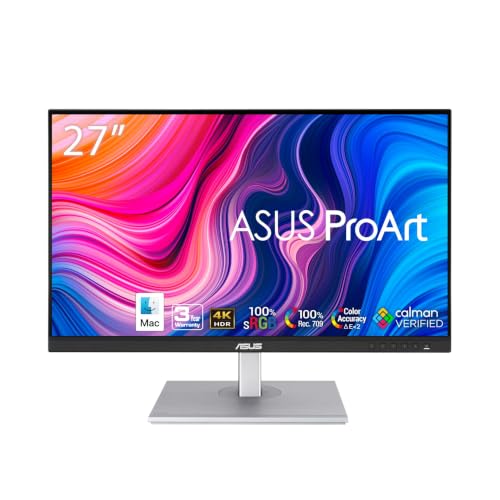
ASUS ProArt PA279CRV 27 Inch 4K UHD USB-C HDR Professional Monitor for Mac

LG 32UR500K-B Ultrafine 32-inch 4K UHD Computer Monitor

More Details On Our Top Picks
This Dell lands in the sweet spot for a Mac desk that has to do a little of everything. The 27-inch 4K panel gives you plenty of room for text, timelines, and side-by-side windows, and the USB-C input makes a cleaner setup for laptops that travel between desk and bag.
Its height, swivel, and pivot adjustments matter more than they sound, especially during long writing sessions or when you want portrait mode for coding and document work. Compared with the Samsung 32-inch option below, this one feels more desk-friendly, though the larger screen there may suit people who want extra scale over compactness.
Strong Points
- 4K resolution keeps text and UI elements crisp on a 27-inch panel.
- USB-C helps reduce cable clutter for MacBook-style setups.
- Height, swivel, and pivot adjustments make it easier to match your posture.
- 99% sRGB coverage supports everyday color work and photo browsing.
- 120Hz refresh can make scrolling and window movement feel smoother than a basic 60Hz screen.
Things To Consider
- 27 inches can feel tighter than 32 inches for split-screen work spread across many windows.
- The stronger gaming focus may be more than you need for plain office use.
- Anti-glare helps in bright rooms, but direct sunlight can still wash out any monitor.
Feature Snapshot
Who It Suits Best
Mac users who want one screen for office work, light creative tasks, and occasional games will get the most from it.
A Better Fit Elsewhere
ASUS ProArt PA279CRV 27 Inch 4K UHD USB-C HDR Professional Monitor for Mac suits color-focused editors more closely, especially when your desk time revolves around accuracy rather than refresh rate.
A 32-inch screen changes the mood of a desk fast, and this Samsung leans into that spacious feel without piling on extras you may not need. The borderless design keeps multi-monitor layouts looking tidy, and the larger panel size helps when you keep reference material, mail, and a main app open together.
The 75Hz refresh rate is a modest step up from standard office panels, so motion feels a little easier on the eyes during daily use. It sits below the Dell 27 S2725QS for speed and adjustability, but for broad workspace comfort, it has a quieter, more relaxed personality.
Upsides
- 32-inch size gives you more room for spreadsheets, timelines, and side-by-side windows.
- Borderless styling keeps the desk looking clean in a two-monitor setup.
- AMD FreeSync can smooth out motion mismatch in compatible use cases.
- Game Mode gives you a quick preset path for mixed work and play.
Room For Improvement
- 75Hz is fine for everyday use, though it’s not in the same league as faster gaming panels.
- Large size needs more desk depth, especially beside a laptop stand or dock.
- Stand flexibility is less clearly positioned than the more adjustable Dell 27 S2725QS.
Quick Facts
Made For
Office users and home shoppers who want a roomy display for general work will find the size especially practical.
Swap It Out When
Dell 32 Monitor S3225QS makes more sense for you when a 120Hz panel and stronger contrast matter more than a simpler 75Hz setup.
This one belongs in the conversation because not every Mac desk is only about office work. The 240Hz panel suits fast motion far better than the 75Hz Samsung or the 120Hz Dell 27 S2725QS, though the 1080p resolution is a clear trade-off for anyone who wants sharp 4K text.
That makes it a better match for gaming-heavy setups, especially for people who split time between a Mac and a console or PC. The IPS panel helps keep colors steady from off-center seats, which is handy in shared spaces, but the lower resolution keeps it outside the purest Mac productivity lane.
Highlights
- 240Hz refresh rate supports very fluid motion for fast-paced games.
- IPS panel keeps the image readable from wide seating angles.
- Two HDMI ports plus DisplayPort make it easy to juggle devices.
- Tilt adjustment gives you a simple way to fine-tune the viewing angle.
Trade Offs
- FHD resolution is less detailed than the 4K picks in this roundup.
- It makes less sense for text-heavy Mac work than a 4K panel.
- Gaming-first tuning may be more than a casual office setup needs.
At A Glance
Right Fit For
Gamers who want a fast second screen beside a Mac will get more value here than creative users chasing pixel density.
Where A Sibling Pick Shines
Dell 27 Monitor S2725QS is the better Mac-first match for everyday desk work, since its 4K panel and USB-C input suit productivity more naturally.
This ASUS sits at the sporty end of the field, and it’s built for people who care as much about speed as they do about sharp detail. The 4K 160Hz mode is the headline, while the dual-mode option pushes FHD up to 320Hz for competitive play, which is far beyond what most Mac productivity screens offer.
The trade-off is obvious: this is a more specialized desk piece than the Dell or LG models. For mixed work and play, USB-C and the wide color claims make it versatile, but the extra gaming hardware only pays off when your setup truly leans that way.
Reasons To Buy
- 4K at 160Hz gives you both detail and speed in one screen.
- Dual-mode support adds a second route for high-refresh gaming.
- USB-C keeps Mac hookups tidy and practical.
- DCI-P3 coverage suits color-rich games and media.
- Tripod socket offers a niche but useful mounting option.
Small Caveats
- The feature set is more elaborate than many Mac-only users will need.
- Gaming focus can push the price and complexity beyond simple office setups.
- At this level, you may end up paying for capabilities you rarely use.
Details At A Glance
Best Suited To
Mac users who also game seriously on the same desk will get the most out of this feature-heavy display.
Another Choice May Suit
ASUS ProArt PA279CRV 27 Inch 4K UHD USB-C HDR Professional Monitor for Mac suits color-focused editors more cleanly, especially when gaming extras are not part of the plan.
This ProArt display is the most obviously work-focused monitor in the group, especially for color-sensitive Mac setups. The factory calibration, Delta E under 2 claim, and wide gamut support are aimed at people who edit photos, cut video, or need a display that stays consistent during visual work.
USB-C with 96W power delivery is the neat part, because it can handle display, data, and charging through one cable, which keeps a small studio desk from getting cluttered. Compared with the Dell 27 S2725QS, it gives up some gaming emphasis and leans much harder into content creation, which is exactly the point.
What We Like
- Factory calibration gives you a stronger starting point for color-sensitive work.
- USB-C with 96W power delivery simplifies laptop docking.
- 99% DCI-P3 and 99% Adobe RGB suit demanding visual tasks.
- Daisy chain support helps tidy up multi-monitor workstations.
- Height adjustment makes it easier to align with your sitting position.
Points To Note
- Professional features raise the bar beyond casual browsing or streaming.
- Color accuracy matters most for people with a clear visual workflow.
- The feature set can feel more serious than a simple home office needs.
Core Details
Who Will Love This
Creative Mac users who need accurate color and a tidy single-cable desk will get the most value here.
Look Elsewhere When
LG 32UR500K-B Ultrafine 32-inch 4K UHD Computer Monitor is the simpler route for general productivity, especially when you want a larger screen without pro-level color features.
The LG 32UR500K-B feels built for people who want a big, simple monitor rather than a feature maze. The 32-inch 4K panel gives you generous room for document work, and the built-in speakers are handy when you want a cleaner desk and don’t want to reach for external audio right away.
OnScreen Control adds a practical layer for desk management, though the software has to be installed, so that’s one more step than a plug-and-go setup. Compared with the ASUS ProArt, this model is less specialized and easier to live with in a general-use home office.
Bright Spots
- 32-inch 4K panel creates a roomy workspace for everyday multitasking.
- Built-in speakers keep the setup simpler for casual media use.
- Borderless styling looks clean on a modern desk.
- HDMI and DisplayPort give you straightforward connectivity choices.
- Reader Mode and Flicker Safe are useful for longer desk sessions.
Areas To Watch
- OnScreen Control needs software installation, which adds a small setup step.
- Built-in speakers suit convenience more than serious audio listening.
- Large size asks for enough desk depth to sit comfortably at arm’s length.
Feature Rundown
The Right Fit
Home office users who want a big screen and straightforward features will likely find this LG easy to settle into.
Where A Sibling Pick Shines
Dell 32 Monitor S3225QS is the better call for people who want a 120Hz panel with stronger contrast and a more gaming-friendly feel.
This Dell 32-inch model is the relaxed alternative to the faster 27-inch picks, and the VA panel gives it a different feel from IPS screens above. VA, or vertical alignment, usually leans toward stronger contrast, so dark scenes and text-heavy work can feel a little richer on the page.
The 120Hz refresh rate still keeps motion comfortably smooth, which helps if your day moves from documents to media to occasional games. For a Mac desk that wants a larger canvas without stepping into pro color territory, it lands in a practical middle ground.
Standout Traits
- 31.5-inch size gives you a broad workspace without jumping into ultra-large territory.
- 3000:1 contrast should suit people who like deeper-looking images.
- 120Hz refresh adds smoothness that ordinary office monitors can’t match.
- 99% sRGB supports dependable everyday color.
- Anti-glare finish helps cut reflections in bright rooms.
Honest Caveats
- VA panels can feel different from IPS if you care about off-angle consistency.
- The size needs a solid desk setup, especially in shallow spaces.
- It’s more comfortable for mixed use than for color-critical creative work.
Technical Sheet
Who Should Grab It
Mac users who want a larger screen for work, entertainment, and occasional gaming will appreciate the balance here.
Not Your Match When
ASUS ProArt PA279CRV 27 Inch 4K UHD USB-C HDR Professional Monitor for Mac is the better route for color-heavy creative work and a tighter USB-C docking story.
How To Choose The Right 4k Monitors For Mac
Start With Screen Size And Desk Depth
A 27-inch monitor usually feels more natural on smaller desks, especially beside a MacBook, keyboard, and dock. A 32-inch panel gives you more breathing room for split windows, but it asks for more depth so the screen does not crowd your face.
Sharpness matters just as much as size. At 4K, a 27-inch display looks very crisp for text and design work, while 32-inch 4K spreads the same detail across a larger surface, which many people prefer for multitasking.
Match The Panel To Your Work
IPS panels tend to keep color and brightness more even from the side, so they suit creative work and shared desks well. VA panels usually lean toward stronger contrast, which can help movies and darker scenes feel richer, though the look can shift more at an angle.
That difference matters more than the spec sheet often makes it sound. A color-focused editor will usually feel happier on an IPS screen such as the ASUS ProArt, while a general-use desk may be perfectly served by the Dell 32 VA model.
Think About Refresh Rate And Motion
Refresh rate is how many times the screen updates each second, and higher numbers usually make scrolling and motion feel smoother. For office work, 60Hz to 75Hz is perfectly usable, but 120Hz becomes noticeable during long days of window switching, and 240Hz is aimed squarely at fast gaming.
That’s why the Dell S2725QS and Dell S3225QS suit mixed use better than many basic office panels. The Dell 27 240Hz gaming monitor goes much further, though its 1080p resolution places it outside the most text-focused Mac setup.
Ports, Power, And Desk Simplicity
USB-C is the easiest path for many Mac desks because it can carry video, data, and sometimes charging in one cable. HDMI and DisplayPort still matter for desktop towers, docking stations, and multiple-device setups, so a monitor with more than one input can save time during daily switching.
Power delivery is especially useful on a MacBook desk. A monitor like the ASUS ProArt PA279CRV keeps the setup cleaner, while a screen without USB-C can still work well, just with more cables and a little more planning.
A Quick Reality Check
Common Shopping Slip Ups
A lot of people focus on resolution and ignore panel size, which is how a panel can look amazing on paper but feel awkward on the desk. Another common miss is buying a fast gaming screen for plain office work, then wondering why the money went to features you rarely notice.
Color coverage gets misunderstood too. Wide gamut numbers help creative work, but they matter less for spreadsheets, web browsing, and everyday app use than for photo and video tasks.
Where The Extra Money Goes
Higher-tier models usually pay for better calibration, wider color support, stronger stand adjustments, and cleaner cable setups. In practice, that means less fiddling with settings, easier posture changes, and a display that better suits demanding visual work.
You’ll notice the upgrade most in a studio, design job, or multi-screen desk where accuracy and comfort matter every day. For lighter use, a simpler monitor can still feel very satisfying without the added cost of specialized features.
Frequently Asked Questions
Is 4K Worth It For A Mac Monitor?
Yes, especially on a 27-inch or 32-inch screen where text can look very crisp. The gain is most obvious during writing, design work, and anything that keeps windows open for long stretches.
Is 27 Inches Or 32 Inches Better?
27 inches suits smaller desks and keeps the view tighter around a laptop. 32 inches gives you more room for multitasking and usually feels better for side-by-side apps.
Do You Need USB-C For A Mac Setup?
No, but it makes the desk cleaner and usually simplifies cable routing. A single USB-C cable is especially convenient for MacBook users who dock and undock often.
What Refresh Rate Makes Sense For Everyday Use?
75Hz is a nice step up from standard office screens, and 120Hz feels smoother still. Faster than that mostly matters for gaming and motion-heavy use.
Is IPS Better Than VA For Mac Work?
IPS is usually the safer choice for color consistency and wider viewing angles. VA can be appealing for contrast, especially on larger screens, but it depends on how you use the monitor.
