
You’re looking at a category where picture quality, motion clarity, and day-to-day comfort all matter at once. That’s especially true for long gaming sessions, mixed work-and-play desks, and living room setups that need strong HDR, deep blacks, and usable text.
The seven picks below cover different priorities, from 27-inch speed-focused panels to 32-inch models that feel more spacious for story games and desktop use. You’ll also see a few practical trade-offs, because a brilliant panel still has to fit your desk, your ports, and your habits.
The Shortlist At A Glance

ASUS ROG PG32UCDM 32 Inch 4K 240Hz OLED Gaming Monitor QD-OLED
Samsung 27” Odyssey OLED G5 (G50SF) Series QHD & QD-OLED Gaming Monitor

ASUS ROG PG32UCDP 32 Inch 4K 240Hz OLED Gaming Monitor
SAMSUNG 27-inch Odyssey QD-OLED G8 (G81SF), 4K, 240Hz, Gaming Monitor
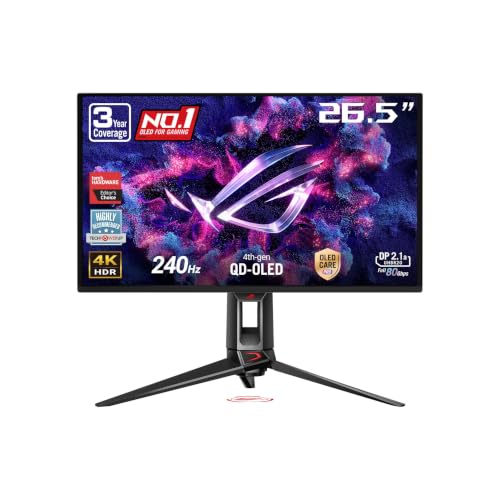
ASUS ROG PG27UCDM 27 Inch 4K 240Hz OLED Gaming Monitor QD-OLED
ASUS ROG XG32UCWG 32 Inch 4K 165Hz Glossy OLED G-SYNC Gaming Monitor

Dell 32 Plus 4K QD-OLED Monitor S3225QC – 31.6-inch
More Details On Our Top Picks
A 32-inch panel with 240Hz refresh and 4K resolution gives you the kind of room that suits both fast shooters and story-heavy games. The USB-C port with 90W power delivery also helps on desks where a laptop shares space with a console or tower, and that keeps cable clutter in check.
The trade-off is simple, it asks for a serious desk and a matching graphics setup to make that 4K speed feel worthwhile. For long sessions, the custom heatsink and graphene film are the details that stand out most, especially compared with the smaller Samsung 27-inch models later in this list.
Strong Points
- 32-inch size gives you a larger working canvas for games, editing, and split-screen multitasking.
- 240Hz at 4K suits you when you want crisp motion without dropping into a lower-resolution mode.
- USB-C with 90W output can simplify a laptop desk by carrying both power and display through one lead.
- The custom heatsink is a practical plus for heavy use, since it supports cooler operation over long sessions.
Points To Note
- This size can feel overkill on a shallow desk, especially if your keyboard sits close to the screen.
- To benefit from 4K at high frame rates, your PC needs enough graphics muscle to keep up.
- The feature set is rich, but that also makes setup more involved than a simple office display.
Feature Card
Who It Suits Best
Competitive and enthusiast gamers with a roomy desk and a strong PC will get the most from this display.
Where A Sibling Pick Shines
ASUS ROG PG27UCDM 27 Inch 4K 240Hz OLED Gaming Monitor QD-OLED fits you better if you want a smaller footprint and still want high-end speed.
This 27-inch model makes a strong case for tighter desks, especially when you want OLED contrast without giving up too much space. QHD resolution means fewer pixels to drive than 4K, so a mid-range gaming PC can feel more comfortable here than it would on the larger ASUS options above.
The 180Hz refresh rate and 0.03ms gray-to-gray response give it a quick feel, though it sits below the 240Hz crowd in this roundup. In a smaller apartment setup or a shared bedroom desk, that balance often makes more sense than chasing the biggest panel available.
What We Like
- 27-inch sizing keeps the footprint manageable on compact desks.
- QHD resolution is easier to drive, which helps you hold smoother frame rates.
- 180Hz still feels fast for everyday gaming, especially in action-heavy titles.
- The very fast response time helps keep motion clean during quick camera movement.
Room For Improvement
- You give up the extra desktop space that 32-inch models provide.
- It does not reach the 240Hz ceiling found on several higher-end picks here.
- QHD is a smart compromise, though you miss some of the crispness that 4K brings for text and detail.
Core Details
Who Will Love This
Space-conscious gamers and apartment setups are the best fit here, especially when you want OLED without a huge desk footprint.
Swap It Out When
ASUS ROG PG32UCDM 32 Inch 4K 240Hz OLED Gaming Monitor QD-OLED suits you better if your desk can handle a larger 4K panel and you want more screen area.
Dual-mode support is the headline here, and it matters because you can lean into 4K at 240Hz for detail or flip to FHD at 480Hz for speed. That kind of flexibility makes more sense for people who move between competitive play and slower cinematic games in the same week.
The custom heatsink adds a practical layer for long sessions, and the 0.03ms response time keeps the motion story consistent with the rest of the high-end field. Compared with the PG32UCDM, this one is less about raw all-around polish and more about letting you choose the pace that fits the game.
Highlights
- Dual-mode operation lets you choose between sharper detail and higher-speed play.
- 32-inch size gives you a roomy image for both games and desktop work.
- The high refresh ceiling makes it a strong fit for competitive genres.
- Custom cooling is a sensible touch for heavy daily use.
Softer Spots
- The added flexibility only matters when your games and PC can take advantage of it.
- A 32-inch panel needs desk depth to feel comfortable at normal sitting distance.
- The feature mix is rich, so setup can take more attention than on simpler displays.
Technical Sheet
Built With In Mind
Competitive gamers who still want a large, high-resolution screen are the best match here.
A Better Fit Elsewhere
Samsung 27” Odyssey OLED G5 (G50SF) Series QHD & QD-OLED Gaming Monitor suits you better if you want a simpler 27-inch setup for a smaller desk.
This Samsung feels like the tidier, more polished cousin to the G5 above. The 27-inch size stays manageable, but 4K detail gives text, interface elements, and fine game textures a cleaner look than QHD usually provides.
DisplayHDR True Black 400 and the ergonomic stand make it a practical choice for mixed use, especially in a desk setup that spends as much time on work as on games. The honest read is that you’re paying for a more finished experience, not just a faster panel.
Positives
- 4K on a 27-inch screen creates very crisp detail density.
- 240Hz keeps motion fluid for twitch games and fast camera movement.
- The ergonomic stand helps you adjust height and angle without adding a third-party arm right away.
- DisplayHDR True Black 400 suggests strong contrast handling for darker game scenes.
Minor Gripes
- A 27-inch 4K panel can feel dense, so some people prefer larger text scaling for daily work.
- The premium feel comes with more cost than the simpler 27-inch G5.
- Desk placement matters, because a smaller screen with very high detail still rewards a careful viewing distance.
At A Glance
The Right Fit
Desk-focused gamers who want a crisp 27-inch screen with a more polished stand are the best match here.
Look Elsewhere When
Samsung 27” Odyssey OLED G5 (G50SF) Series QHD & QD-OLED Gaming Monitor suits you better if you want to spend less and can live with QHD instead of 4K.
Here the focus shifts from raw speed to upkeep-minded features that matter over long ownership. OLED Care Pro and the Neo Proximity Sensor are built to reduce the chance of a static image sitting on screen for too long, which is useful on a work-gaming desk where menus, taskbars, and launcher windows stay open.
DisplayPort 2.1 also gives this model a more future-facing connection than some of the others here. Compared with the PG32UCDM, it trades the bigger 32-inch canvas for a more compact footprint, and that’s often the better fit for smaller desks or dual-monitor layouts.
Upsides
- The 27-inch size works well on desks where a 32-inch panel would feel too large.
- 4K at 240Hz gives you high detail without leaving fast motion behind.
- The proximity sensor adds a sensible layer for periods when you step away from the desk.
- DisplayPort 2.1 is a useful detail for people building a newer PC setup.
- The custom heatsink supports practical thermal management during long play sessions.
Worth Noting
- Small desks still need careful spacing, because 27-inch 4K can look dense up close.
- The extra care features matter most for static-heavy routines, so pure gaming-only setups may value them less.
- It sits at a higher tier than the Samsung G5, so the extra spend makes sense mainly for feature depth.
Feature Rundown
Perfect Match For
Compact high-end gaming desks and mixed-use setups are the sweet spot here.
Reach For A Different Pick When
ASUS ROG PG32UCDM 32 Inch 4K 240Hz OLED Gaming Monitor QD-OLED suits you better if you want a larger screen and more presence on the desk.
The glossy WOLED finish is the headline here, and that gives it a different visual character from the more common matte-style gaming monitors. The trade-off is familiar, glossy panels can look gorgeous in controlled light, yet they also ask for smarter room placement than a darker, reflection-tolerant setup.
Its 4K at 165Hz mode is a notch lower in refresh than the 240Hz crowd, but the dual-mode FHD 330Hz option keeps it flexible. For style-focused desks, especially paired with PS5 or Xbox use, this one feels like the monitor you choose when image character matters as much as raw speed.
Best Bits
- Glossy OLED finish gives the image a distinct, high-impact look in calmer lighting.
- 32-inch size works well for console play and roomy desktop use.
- Dual mode adds a faster FHD option for moments when motion matters more than detail.
- Auto KVM support helps a shared desk switch between devices more cleanly.
Areas To Watch
- Glossy panels can show room reflections more readily than subdued finishes.
- 165Hz is still fast, though it trails the 240Hz models in this roundup.
- Dual-mode displays work best when you actually plan to use both modes regularly.
Details At A Glance
Whose Shelf It Belongs On
Style-conscious gamers and console setups are the best match here, especially where room lighting can be controlled.
Another Choice May Suit
ASUS ROG PG32UCDM 32 Inch 4K 240Hz OLED Gaming Monitor QD-OLED is the better fit if you want a faster 240Hz cap and do not care as much about the glossy finish.
This Dell leans more toward entertainment and mixed use than pure esports urgency. The 31.6-inch QD-OLED panel gives you a roomy image, and the built-in 3D spatial audio with five 5W speakers means you may not need separate speakers right away for a casual media desk.
Its 120Hz ceiling is lower than the gaming-first ASUS and Samsung options above, so the appeal is different. For someone splitting time between games, streaming, and everyday desktop work, that lower speed can still feel perfectly reasonable, especially with height, tilt, swivel, and slant adjustment on the stand.
Positives
- The 31.6-inch size gives you a broad, comfortable viewing area.
- Built-in spatial audio reduces the need to plan around separate desktop speakers.
- Five 5W speakers make it more self-contained for a media-heavy desk.
- Multiple stand adjustments help you line up the screen more comfortably.
Honest Caveats
- 120Hz is fine for many uses, though it trails the faster gaming panels in this lineup.
- The audio focus makes it feel less like a pure gaming monitor and more like a hybrid setup piece.
- Its value depends on whether you want speakers built in or already have a sound setup you like.
Core Details
Made For
Mixed-use desks that lean toward entertainment, media, and everyday comfort are the best fit here.
Where Shoppers Go Wrong
ASUS ROG PG32UCDM 32 Inch 4K 240Hz OLED Gaming Monitor QD-OLED suits you better if gaming speed matters more than built-in audio features.
How To Choose The Right 4k Woled Monitors
Screen Size And Desk Depth
A 27-inch panel fits cramped desks more easily, while a 32-inch display gives you more room for games, timelines, and multitasking. That difference matters more than it sounds, because a larger screen can feel immersive or simply too close, depending on how deep your desk runs.
4K on 27 inches looks very dense, which helps text and fine detail stand out. 4K on 32 inches feels a little more relaxed at normal sitting distance, so many gamers and hybrid work setups find that size easier to live with.
Refresh Rate Versus Game Type
Refresh rate tells you how many times per second the display updates, so higher numbers usually feel smoother during fast motion. A 240Hz panel suits twitch shooters and fast camera movement, while 120Hz or 165Hz can still feel clean for slower genres, console play, and everyday use.
The real choice is about priorities. If your sessions lean competitive, higher refresh matters more than speaker extras or glossy finishes.
OLED Flavor And Panel Care
QD-OLED and WOLED are both OLED families, but they can present image character a little differently, especially in color volume and finish choices. QD-OLED models often focus on vivid color and bright highlight punch, while glossy WOLED options tend to look especially rich in controlled lighting.
Panel care features matter too, especially on a desk that shows static taskbars, launchers, or chat windows for hours. Cooling aids, proximity sensors, and screen-care software are the details that make sense for long ownership, not just launch-day excitement.
Ports, Stands, And Everyday Setup
USB-C with power delivery is useful for laptop desks, because one cable can carry video and charge. DisplayPort 2.1 is worth paying attention to on newer PC builds, while Auto KVM helps when you swap between a desktop and a console or work machine.
Stand adjustment also changes the experience more than many people expect. Height, tilt, swivel, and pivot support can save you from buying an arm right away, and that’s a practical win for most home setups.
A Quick Reality Check
Common Shopping Slip Ups
A lot of people focus on the panel type and forget desk space, lighting, or graphics power. A 32-inch 4K monitor looks fantastic, but it can feel cramped on a shallow desk and demanding on a weaker GPU.
Another common miss is treating every OLED the same. Glossy panels, high-refresh panels, and screen-care models each solve different problems, so your room and usage pattern matter as much as the spec sheet.
What The Higher Tier Buys
Higher-tier models usually pay for faster refresh, better cooling, more flexible connections, and extra care features that help with long-term use. That’s why the premium ASUS picks sit above the simpler Samsung G5, they give you more headroom and more control.
The upgrade pays off most for mixed gamers who also use the monitor for work, consoles, or long daily sessions. In a setup like that, the extra ports and panel-care tools feel less like luxury and more like sensible insurance.
Frequently Asked Questions
What makes 4k Woled Monitors different from regular gaming monitors?
They combine 4K detail with OLED-style contrast, so dark scenes tend to look deeper and highlights can stand out more clearly. The WOLED label points to the panel family, which many shoppers prefer for gaming and mixed-use desks.
Is 240Hz worth it on a 4K panel?
It matters most for fast-paced gaming, especially when you care about motion smoothness. For slower genres or casual use, 120Hz or 165Hz can still feel plenty fluid.
Are 27-inch or 32-inch models better?
27-inch models fit smaller desks and look very crisp at 4K. 32-inch models feel more spacious and are usually easier on the eyes for long sessions.
Do OLED care features really matter?
They matter most on desks with static taskbars, launchers, or work windows. Features like cooling support and proximity sensing are practical because they help the monitor handle everyday habits more gracefully.
Should you choose QD-OLED or WOLED?
QD-OLED often appeals to shoppers who want vivid color and strong highlight pop. WOLED can be a better match if you want a different panel character, especially on models with glossy finishes or flexible gaming modes.
