
Curved QHD gaming monitors make sense for you when desk space, motion clarity, and frame pacing all matter at once. A tighter curve can feel more enveloping at a single seat, while 1440p gives you a cleaner middle ground than plain 1080p. The seven picks below lean into different strengths, from fast esports panels to larger curved screens that suit long sessions and mixed use.
Quick Look At Our Top Picks

KTC H32C5 32 Inch Curved Gaming Monitor

Dell SE2726HG 27 240Hz Gaming Monitor

Samsung Odyssey G5 (G51F) 27 QHD Gaming Monitor

ASUS TUF Gaming VG32WQ3B 31.5 Curved HDR Monitor

AOC CQ27G4H 27 Curved Gaming Monitor
Acer Nitro XZ320QU S3 31.5 Curved Gaming Monitor
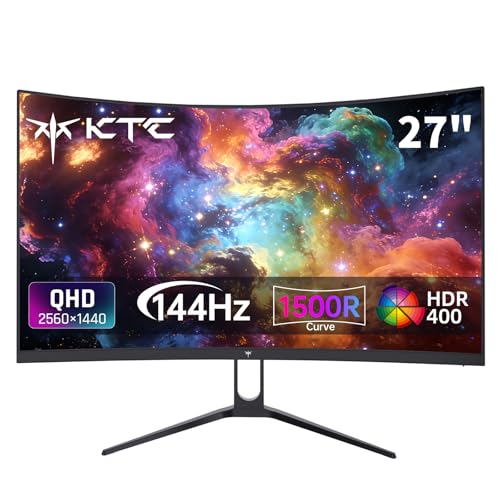
KTC H27S5C 27 Inch Curved Gaming Monitor
More Details On Our Top Picks
Speed is the whole point here, and the 32-inch curved panel gives that fast-motion feel more room to breathe than the smaller 27-inch options below. The 1500R curve, Adaptive-Sync, HDR, and 128% sRGB coverage point to a screen built for smooth play first, with a wide color gamut that helps the image avoid looking flat.
The trade-off is plain: this is still a Full HD panel, so text sharpness and desktop density trail the QHD models in this roundup. For a gaming-first setup, especially on a larger desk, that balance can still make sense because the 280Hz ceiling and 3500:1 contrast ratio focus attention where fast action matters.
Strong Points
- 280Hz support suits fast-paced play and keeps motion looking very fluid.
- 32-inch size fills more of your view, which helps in racing, FPS, and cockpit-style games.
- Adaptive-Sync helps reduce visible tearing with compatible graphics hardware.
- 128% sRGB coverage gives color a richer look for games and everyday media.
- 3500:1 contrast ratio should help dark scenes carry more depth than a flat IPS-style panel.
Things To Consider
- 1080p on 32 inches is a clear step down in sharpness from the QHD monitors in this list.
- The fast, gaming-led design leaves less focus for mixed office work.
- Owners who care about crisp text may prefer a smaller or higher-resolution panel.
Feature Snapshot
Who It Suits Best
Competitive gamers who want a large curved panel and prioritize motion over pixel density will get the most out of this one.
Where A Sibling Pick Shines
Samsung Odyssey G5 (G51F) 27 QHD Gaming Monitor suits you better for sharper 1440p desktop work and a more balanced game-and-work setup.
Dell takes a cleaner, more restrained route than the KTC H32C5, which makes sense for desks that do double duty. The IPS panel should suit you well for wider viewing angles, and the 27-inch size keeps the full HD resolution from feeling as stretched as it can on a larger screen.
Its tilt-only stand is simple rather than flexible, so monitor arms or risers become more appealing in a tidy setup. That’s the honest read: this looks like a strong fit for a compact gaming station where you still want fast refresh, two HDMI ports, and DisplayPort 1.4 without a lot of extra clutter.
What We Like
- 240Hz refresh rate gives you very quick motion handling for competitive games.
- IPS technology usually brings broader viewing angles than curved VA-style options.
- Two HDMI ports plus DisplayPort 1.4 make source switching straightforward.
- 27-inch sizing keeps the desk footprint sensible.
Worth Noting
- Full HD is functional, but not as crisp as the QHD picks in this roundup.
- The stand only tilts, so height changes may call for extra hardware.
- Flat-screen design gives less wraparound feel than the curved models here.
Core Details
Made For
Desk-first gamers who want fast refresh, broad viewing angles, and a compact footprint will find this a sensible match.
A Better Fit Elsewhere
AOC CQ27G4H 27 Curved Gaming Monitor suits you better for a curved QHD image and a stronger upgrade path from 1080p.
The Samsung G5 shifts the emphasis toward a more complete 1440p gaming package. Compared with the Dell and KTC 1080p panels, you get more usable desktop space and a sharper look for text, maps, and HUD elements, which matters a lot on a daily gaming-and-browsing setup.
The height-adjustable stand is a useful comfort touch, especially on a desk where your seating position changes through the day. Black Equalizer, Virtual Aim Point, and Auto Source Switch+ add practical gaming convenience, though the trade-off is that this one leans more feature-rich than minimalist.
Upsides
- QHD resolution gives you a notably cleaner image than the FHD models here.
- 180Hz refresh rate keeps pace with fast action without pushing into extreme territory.
- Height adjustment helps you match the screen to your seating position.
- Black Equalizer and Virtual Aim Point are useful gaming tools for common console and PC setups.
- Auto Source Switch+ is handy when you keep more than one device connected.
Points To Note
- 1ms response time is strong on paper, but your graphics setup still shapes the final feel.
- The feature set may be more than you need for a basic casual desk.
- Samsung’s extras are useful, yet they can add cost compared with simpler curved panels.
Details At A Glance
Best Suited To
PC and console gamers who want sharper QHD detail, adjustable ergonomics, and useful on-screen gaming tools will get the most from this monitor.
Look Elsewhere When
Acer Nitro XZ320QU S3 31.5 Curved Gaming Monitor is the better match for you if a larger curved panel matters more than Samsung’s extras.
ASUS pushes size and responsiveness together in a way that suits a serious gaming desk. The 31.5-inch QHD panel gives you more room than the Samsung G5, while the 1500R curve and 180Hz refresh rate keep the experience focused on immersion and motion clarity rather than extras.
That balance makes sense for story-driven games, racing titles, and all-day general use, especially since the 90% DCI-P3 color space should help the screen avoid looking washed out. The catch is simple: a monitor this large needs enough depth on the desk, or the edges can sit closer than you want.
Best Bits
- 31.5-inch QHD panel gives you generous screen space for gaming and side-by-side windows.
- 180Hz and 0.5ms response time support quick movement with little blur on paper.
- Extreme Low Motion Blur targets sharper-looking motion in fast scenes.
- 90% DCI-P3 coverage helps color look fuller than many plain gaming panels.
- DisplayWidget adds a convenient software layer for adjusting the monitor from your desktop.
Room For Improvement
- The large footprint demands a deeper desk and careful placement.
- At 31.5 inches, 1440p is comfortable, but smaller desks may feel crowded.
- Features are focused on gaming rather than broad productivity extras.
Spec Overview
Whose Shelf It Belongs On
Gamers who want a larger curved QHD screen and have enough desk space for it will find this ASUS a strong fit.
Reach For A Different Pick When
Samsung Odyssey G5 (G51F) 27 QHD Gaming Monitor is the cleaner choice for a smaller desk and a more compact 27-inch footprint.
The AOC CQ27G4H lands in a practical sweet spot: curved, QHD, and quick without piling on unnecessary extras. Compared with the ASUS VG32WQ3B, it gives you a more compact 27-inch footprint, which is easier to place on average desks and still feels plenty sharp at 1440p.
The 0.5ms response figure, HDR support, and console-ready input mix make this a tidy fit for a living-room style setup or a desk that handles both console and PC. Zero Bright Dot coverage over three years is notable, though the real value here is the straightforward spec list that keeps the budget pointed at core performance.
Reasons To Buy
- QHD resolution gives you a crisp step up from 1080p.
- 27-inch curved size works well on standard desks.
- 0.5ms rating keeps motion-focused gaming high on the list.
- DP 1.4 and HDMI 2.0 help with PC and console connections.
- Earphone output adds a simple audio route for personal setups.
Softer Spots
- VA panels can show different contrast and viewing behavior than IPS models.
- The feature set stays focused, so you do not get many extra comfort tools.
- Console-ready design is useful, but it still needs the right game settings to shine.
Feature Card
The Right Fit
Gamers who want a clean curved 1440p monitor with a sensible size and simple connectivity will get solid mileage from this AOC.
Skip It When
ASUS TUF Gaming VG32WQ3B 31.5 Curved HDR Monitor suits you better if you want a larger, more immersive screen and have the desk space for it.
Acer splits the difference between a gaming screen and a more versatile desk monitor. The 31.5-inch QHD panel gives you plenty of room for a timeline, browser tabs, or a game HUD, while the included speakers and ergonomic stand make it easier to fit into a simple home setup.
Compared with the AOC and ASUS models, this one feels especially useful when your monitor has to handle more than one role in a day. The 1500R curve, DisplayPort, two HDMI inputs, VESA mounting support, and blue-light filter all point to a monitor built for straightforward ownership, though built-in speakers rarely replace a proper audio setup.
Bright Spots
- 31.5-inch QHD panel offers strong workspace room without jumping to ultrawide sizes.
- 180Hz refresh rate and 1ms response rating support fast-paced gaming.
- Ergo stand adds useful positioning flexibility for mixed-use desks.
- Two HDMI ports and DisplayPort make device swapping simple.
- VESA mounting support lets you move it onto an arm or wall mount.
Areas To Watch
- Built-in speakers are convenient, but many setups will still benefit from separate audio.
- Large size can feel broad on a shallow desk.
- The blue-light filter and mounting support are practical, though they do not replace a careful lighting setup.
Technical Sheet
Built With In Mind
Home gamers who also want a roomy screen for everyday tasks and an easier setup path will appreciate what this Acer brings.
Swap It Out When
KTC H27S5C 27 Inch Curved Gaming Monitor is the better match for smaller desks that need a brighter-feeling compact panel.
KTC’s 27-inch H27S5C gives you the cleanest shape for a modest desk among the curved options here. The 1440p panel, 1500R curve, 400-nit brightness figure, and 129% sRGB coverage make it feel like a serious step up from ordinary 1080p screens without demanding much space.
The 144Hz ceiling keeps this one in the mainstream gaming lane rather than the extreme high-refresh lane of the KTC H32C5 or Dell SE2726HG. That’s a sensible trade for everyday use, especially when eye-care support, VESA 100×100 mounting, HDMI and DisplayPort inputs, and Adaptive Sync all help it fit neatly into a desk setup that has to stay tidy.
Highlights
- 27-inch size is easy to place on smaller desks.
- 1440p resolution gives you noticeably better detail than 1080p panels.
- 400-nit brightness figure helps the screen hold up in brighter rooms.
- Adaptive Sync supports smoother motion with compatible hardware.
- VESA 100×100 support lets you mount it cleanly.
Small Caveats
- 144Hz is solid, though it sits below the faster options in this roundup.
- The HVA panel may suit many gamers, but it still has a different look from IPS.
- The spec mix is practical rather than flashy.
Feature Rundown
The Right Fit
Gamers who want a compact curved 1440p monitor for a tidy desk and don’t need extreme refresh rates should look closely at this KTC.
Another Choice May Suit
Dell SE2726HG 27 240Hz Gaming Monitor is the better match for you if speed matters more than 1440p detail and a curved panel.
How To Choose The Right 1440p 144hz Curved Monitors
Start With Screen Size And Desk Depth
Size changes the whole feel of a curved monitor. A 27-inch panel sits more comfortably on a typical desk, while 31.5-inch models create a wider, more immersive field that needs deeper furniture and a little more viewing distance.
The curve matters most when the screen fills your forward view. A 1500R curve, common across several picks here, bends the display more tightly around your sightline than a gentler curve, so it tends to suit single-seat gaming setups better than shared spaces.
Match Resolution To What You Actually Do
1440p, also called QHD, gives you more desktop room and finer detail than 1080p. That extra sharpness pays off in strategy games, busy RPG interfaces, and everyday multitasking, especially on 27-inch and larger panels.
By contrast, a 1080p curved screen at 32 inches can still make sense for fast play because the lighter pixel load helps the frame rate stay high. The trade-off is obvious, text looks softer, so that route fits gaming-first desks better than mixed work stations.
Look Closely At Refresh Rate And Response Time
Refresh rate is how many times per second the image can update, so 144Hz and 180Hz already feel smooth, while 240Hz and 280Hz push motion clarity further for competitive play. Response time describes how quickly pixels change shade, and lower figures usually help moving objects leave less trailing blur.
You do not need the highest number on the page for every setup. A stable 144Hz or 180Hz curved QHD monitor often lands in the sweet spot for most single-PC gaming rooms, while extreme refresh belongs to players who spend a lot of time in fast shooters or racing titles.
Check Stand, Mount, And Input Details
Height adjustment, tilt, and VESA mounting can matter as much as panel specs once the monitor is on your desk. A fixed stand is fine for a simple setup, but an adjustable one helps you line up the screen with your chair and reduce awkward neck angles.
Ports also shape ownership. Dual HDMI, DisplayPort, and earphone output make life easier when you swap between a console, a gaming PC, and a media box, so the cleanest choice is often the one that fits your actual cable layout.
Things Worth Knowing First
Mistakes Worth Dodging
One common slip is chasing refresh rate while ignoring resolution. A very fast 1080p panel can feel smooth, but a 1440p screen usually looks better for text, maps, and everyday desktop use.
Another is buying a large curved monitor without checking desk depth. A 31.5-inch display can overwhelm a shallow surface, while a 27-inch model often sits more comfortably in a normal room.
The Upgrade Payoff
Higher-tier curved monitors usually cost more because of the panel quality, larger size, stronger motion tuning, and extras like height adjustment or software controls. Those features matter most when you spend long hours at the desk and want the screen to feel less fatiguing and more flexible.
That extra spend is easier to justify for people who game daily, connect multiple devices, or care about smoother motion at high refresh. For a casual setup, a simpler 27-inch QHD panel often gives the better balance.
Frequently Asked Questions
Are 1440p curved monitors better than 1080p curved monitors?
1440p gives you finer detail and more room for multitasking. 1080p can still be a smart choice for very high refresh at a lower hardware load.
What size curved monitor works best for gaming?
27 inches is the easiest fit for most desks. 31.5-inch models feel more immersive, but they need more space and a longer viewing distance.
Is 144Hz enough for fast gaming?
Yes, 144Hz already feels smooth for a lot of play styles. Higher refresh rates help even more in fast shooters and racing games.
Do curved monitors help with everyday work?
Curved screens can feel more comfortable in a single-seat setup because the edges sit a bit closer to your view. They still depend on the panel type and stand adjustability for all-day comfort.
Should you choose IPS or VA for a curved monitor?
IPS usually gives wider viewing consistency, which helps on shared desks or multi-use setups. VA often brings stronger contrast, which many gamers like for darker scenes.
Final Verdict
Your best choice depends on how much space you have and how you use the screen. The KTC H32C5 and Dell SE2726HG lean hard into speed, the Samsung and AOC models feel more balanced, and the ASUS or Acer makes more sense when you want a larger curved panel with room to spare. The KTC H27S5C sits neatly for smaller desks that still want QHD clarity. Pick the one that matches your desk, your hardware, and the way you spend your evenings.
