
You want a monitor that can keep up with fast movement without giving up 4K detail, and that’s a narrow lane. These seven picks cover different screen sizes, panel types, and gaming features, so you can match the display to your desk, console setup, or PC habit. Some lean toward speed, others toward richer contrast or easier day-to-day use. The right one feels less like a spec sheet and more like a clean fit for your space.
The Shortlist At A Glance

Dell 27 Monitor S2725QS 4K UHD IPS 120Hz

Samsung 27 Odyssey G5 G51F QHD Gaming Monitor 180Hz
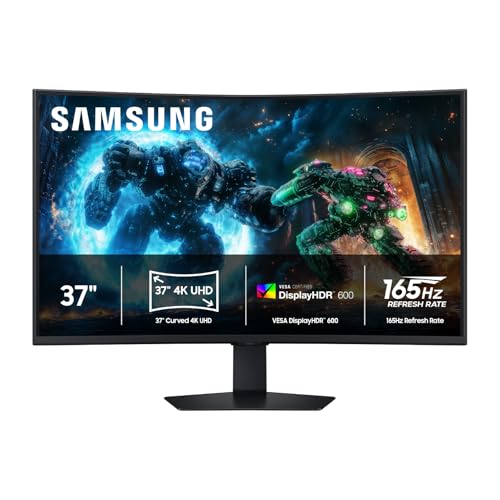
Samsung 37 Odyssey G7 G75F 4K UHD Curved Gaming Monitor 165Hz

ASUS TUF Gaming 27 VG27UQ1A 4K HDR Monitor 160Hz
ASUS ROG XG32UCWG 32 Inch 4K 165Hz Glossy OLED Gaming Monitor

LG 32GX850A-B 32 UltraGear 4K UHD Glossy OLED Gaming Monitor

msi MAG 321CUP QD-OLED 32-Inch 4K UHD OLED Monitor 165Hz
More Details On Our Top Picks
The Dell S2725QS fits the person who wants a clean 27-inch 4K screen without drifting into flashier gaming extras. IPS means in-plane switching, which usually helps keep color and viewing angles steady, and the anti-glare finish suits a bright desk or a room with windows.
Its 120Hz refresh rate sits below the faster gaming-first models here, but that trade-off often makes sense for daily work, streaming, and casual play. USB-C, HDMI, DisplayPort, and height, swivel, plus pivot adjustment make it easier to match a laptop desk than the more gaming-heavy picks from Samsung and ASUS.
What We Like
- 4K resolution gives you crisp text and more room for editing, spreadsheets, and browser tabs.
- USB-C simplifies a laptop setup and helps keep cable clutter under control.
- Height, swivel, and pivot adjustment make it easier to dial in a comfortable viewing angle.
- 99% sRGB coverage suits color-aware everyday work and general content creation.
- Anti-glare coating helps in rooms with overhead light or a nearby window.
Things To Consider
- 120Hz is smooth, but it trails the 160Hz to 165Hz gaming models in this lineup.
- Five milliseconds of response time is fine for general use, though fast shooters will usually favor a quicker panel.
- 27 inches keeps the desk footprint modest, yet some gamers may want a larger curve or OLED contrast instead.
Feature Snapshot
Who It Suits Best
You get the most from this one if your desk does double duty for work, streaming, and casual gaming.
A Better Fit Elsewhere
Samsung 37 Odyssey G7 G75F 4K UHD Curved Gaming Monitor 165Hz suits you better for a wider, more immersive gaming layout.
Samsung’s Odyssey G5 shifts the focus toward speed, so it makes sense for competitive play more than desktop polish. QHD means 2560 x 1440 resolution, which is easier to drive at high frame rates than 4K, and that matters on a system that lives for fast shooters or racing games.
Black Equalizer, Virtual Aim Point, and Auto Source Switch+ are practical extras, especially on a console-and-PC desk where you swap inputs often. The height-adjustable stand helps, though the overall value here comes from responsiveness rather than the richer image or sharper text you get from the 4K picks above.
Upsides
- 180Hz refresh rate gives you a fast feel for twitch-heavy games.
- One millisecond response time helps keep motion looking cleaner during quick camera movement.
- HDR10 support adds another layer for supported games and video.
- Auto Source Switch+ is handy on mixed-input desks with a console and a PC.
Points To Note
- QHD is a step down in pixel density from the 4K models in this roundup.
- That faster frame focus makes it less of a work-first display for text-heavy multitasking.
- Owners with a cluttered desk may still want extra attention on cable routing, since the stand helps but does not erase the footprint.
Core Details
Best Suited To
You get the best match here if your main priority is competitive gaming and you care more about speed than 4K detail.
Another Choice May Suit
Dell 27 Monitor S2725QS 4K UHD IPS 120Hz suits a mixed work-and-play desk more cleanly.
The 37-inch size changes the whole feel of the desk, especially if you like a wider field of view for racing, RPGs, or cockpit-style games. The curve wraps the panel inward, which can make the screen feel more enveloping without pushing you into ultrawide territory.
It also brings DisplayHDR 600, a higher HDR tier that usually signals more headroom for bright highlights, though results still depend on content and settings. Compared with the Dell and ASUS 27-inch options, this one asks for more space, but it gives you a roomier canvas for both play and split-window use.
Best Bits
- 37-inch size gives you a broad, cinematic feel on a large desk.
- 165Hz keeps movement responsive while still staying in the 4K lane.
- DisplayHDR 600 points to stronger contrast handling in supported content.
- AMD FreeSync Premium Pro suits tear-conscious gaming on compatible hardware.
Room For Improvement
- That large curved frame needs more desk depth than the 27-inch picks.
- It can feel oversized for compact home-office setups.
- Cleaning and cable access are less convenient once it’s placed and aligned.
Feature Rundown
The Right Fit
You’ll appreciate this most if you have the desk space for a large curved display and want a more enveloping gaming view.
Where A Sibling Pick Shines
ASUS TUF Gaming 27 VG27UQ1A 4K HDR Monitor 160Hz fits better for smaller desks that still need high refresh and 4K.
ASUS builds this one for someone who wants a faster 4K monitor without moving into OLED pricing territory. Extreme Low Motion Blur Sync is ASUS’s motion-smoothing approach, and 95% DCI-P3 matters because DCI-P3 is a wider color space used for richer-looking video and game art.
It feels well suited to a gaming desk that also sees everyday desktop work, since 27 inches keeps it compact while 160Hz gives you a clear step up from 60Hz or 120Hz panels. The trade-off is simple, though, it gives you fewer luxury features than the OLED entries farther down this list.
Highlights
- 160Hz refresh rate keeps the display in the fast-response class.
- FreeSync Premium and G-SYNC compatibility widen GPU matching options.
- 95% DCI-P3 suits richer-looking games and media.
- DisplayWidget can make on-screen adjustment easier from the desktop.
Softer Spots
- It does not bring the deeper black levels of OLED.
- 27 inches can feel tight for split-screen work compared with 32-inch and 37-inch picks.
- The included feature set is practical, but not as lavish as the higher-tier ASUS ROG option.
Details At A Glance
Whose Shelf It Belongs On
You’ll like this most if you want a fast 4K panel for a compact gaming desk with everyday versatility.
Swap It Out When
LG 32GX850A-B 32 UltraGear 4K UHD Glossy OLED Gaming Monitor suits you better if you want OLED contrast and a larger 32-inch canvas.
This ASUS ROG model is aimed at the person who wants OLED contrast, 4K sharpness, and a monitor that can also flex into high-speed lower-resolution mode. Dual Mode means it can shift to a faster Full HD refresh setting, which gives competitive players a second gear that the Dell and Samsung 27-inch entries do not offer.
The glossy OLED finish tends to make colors and dark scenes feel especially striking, though that same glossy surface can also be more sensitive to room lighting than a matte panel. Auto KVM is a nice touch on a desk shared by a PS5 and Xbox, since KVM lets one keyboard and mouse control more than one device.
Reasons To Buy
- OLED panel technology gives you very deep blacks and high contrast.
- Dual Mode adds a faster Full HD setting for speed-focused play.
- Auto KVM is useful on console-heavy desks with shared peripherals.
- 0.03ms response time is extremely quick on paper.
- 32 inches offers a larger image than the 27-inch gaming options.
Small Caveats
- The glossy finish can reflect more room light than a matte screen.
- OLED owners usually stay attentive to static desktop habits, so careful use matters more than with LCD panels.
- The feature set is rich, but it also makes this a more specialized pick than the Dell or ASUS TUF models.
Quick Facts
Who Should Grab It
You’ll get the most out of this if you want OLED contrast and you split time between console play and PC gaming.
Reach For A Different Pick When
Samsung 37 Odyssey G7 G75F 4K UHD Curved Gaming Monitor 165Hz fits better if you want a larger curved display without glossy OLED handling.
LG leans hard into the premium side here, with a 32-inch glossy OLED panel and a dual-mode setup that jumps from 4K 165Hz to FHD 330Hz. That second mode makes sense for esports nights, while the 4K mode keeps the desktop sharp enough for everything from games to media work.
The stand moves through tilt, height, swivel, and pivot, so it gives you more positioning freedom than the more fixed-feeling premium panels. Compared with the ASUS ROG OLED, this one is a little more straightforward in name and layout, but the feature mix still aims squarely at serious gaming use.
Bright Spots
- Dual-mode operation gives you both 4K detail and a faster esports setting.
- OLED contrast helps dark scenes carry more depth.
- 0.03ms response time is extremely quick for motion-heavy play.
- HDMI and DisplayPort keep connection options practical.
- The full range of stand adjustments makes placement easier on different desks.
Trade Offs
- Glossy OLED can be more demanding in bright rooms.
- Thirty-two inches needs more desk width than a 27-inch panel.
- The premium feature mix naturally puts this above simpler LCD choices.
Technical Sheet
Perfect Match For
You’ll appreciate this most if you want a premium 32-inch OLED for a serious gaming desk with room to spare.
Look Elsewhere When
Dell 27 Monitor S2725QS 4K UHD IPS 120Hz makes more sense for a simpler all-purpose setup.
MSI’s 32-inch QD-OLED panel lands in a sweet spot for someone who wants the rich contrast of OLED without moving to a huge curved shell. QD-OLED combines quantum-dot color tuning with OLED blacks, which usually gives you a strong mix of saturation and depth for games and movies.
HDMI 2.1, DisplayPort 1.4a, and USB-C with 15W power delivery make it easier to plug in modern gear, and the tilt-plus-height stand keeps the desk side practical. Compared with the LG and ASUS ROG OLED options, this one looks a little more restrained on paper, which may suit you better if you want the screen to do the work without extra showmanship.
Positives
- QD-OLED brings deep blacks and strong color pop.
- 165Hz keeps motion smooth for games that reward speed.
- USB-C with 15W power delivery suits cleaner laptop docking.
- HDMI 2.1 supports modern console and PC connections.
- 32 inches gives you a comfortable middle ground between compact and oversized.
Areas To Watch
- QD-OLED care habits matter more than they do on standard LCD monitors.
- 15W USB-C power is useful for connectivity, but it’s not a full laptop charging setup.
- The 32-inch size still asks for a fair amount of desk depth.
Feature Card
Built With In Mind
You’ll get the most from this if you want a 32-inch OLED that handles gaming and general media with equal ease.
Skip It When
Samsung 27 Odyssey G5 G51F QHD Gaming Monitor 180Hz fits you better if your priority is competitive speed over premium image quality.
How To Choose The Right 165hz 4k Monitors
Match Resolution To Your Actual Desk Use
4K gives you sharper text, cleaner UI edges, and more room for windows, which helps a work-first desk feel less cramped. On a 27-inch screen, that sharpness is easy to appreciate, while 32-inch and 37-inch panels spread it across a larger canvas.
High refresh only matters when your PC or console can push enough frames to use it. A 165Hz panel that spends its life at low frame rates still looks good, but the speed advantage is smaller than the spec line suggests.
Choose The Panel Type For The Way You Sit
IPS panels usually suit bright rooms and shared desks because color and contrast stay steadier from the side. OLED and QD-OLED panels bring richer blacks and stronger perceived depth, but glossy finishes can reflect more room light.
That trade-off matters in real homes, especially with windows, lamps, or overhead lighting. Matte IPS feels safer for all-day office use, while glossy OLED feels more dramatic in a dim gaming space.
Size, Curve, And Stand Adjustability Change Comfort
Twenty-seven inches stays compact and easy to place, which helps on narrow desks or in a bedroom setup. Thirty-two inches gives you more presence, and 37 inches starts to feel immersive enough for sim racing or wide-screen multitasking.
Curve can pull the screen into your field of view, though it also takes more space to position cleanly. Height, swivel, and pivot adjustment matter more than people expect, because a good stand can save your neck during long work or gaming sessions.
Look Closely At Ports And Gaming Extras
HDMI 2.1, DisplayPort, and USB-C solve different setup problems, so the right mix depends on your devices. USB-C helps a laptop desk, while HDMI 2.1 matters more for modern consoles and high-bandwidth video paths.
Extras such as G-SYNC, FreeSync, Auto KVM, and source switching are not decoration. They reduce friction for mixed setups, shared peripherals, and frame-sync needs, which is where a premium monitor starts feeling worth the step up.
What To Weigh Before You Click
Common Shopping Slip Ups
Many people fixate on refresh rate and miss the panel type, which changes color, contrast, and room-light behavior just as much. Desk size gets overlooked too, and a 32-inch or 37-inch screen can crowd a small workstation fast.
Another common miss is assuming every 4K monitor will feel equally good with a console or laptop. Ports, stand adjustment, and sync support often matter more than the headline resolution alone.
Where The Extra Money Goes
Higher-tier models usually pay for OLED or QD-OLED panels, faster response behavior, better stand hardware, and richer port sets. You also tend to get extras like KVM switching, broader sync support, and more polished motion tuning.
That upgrade makes sense when the screen is a daily center point for gaming and media, not just a display on the side. For casual use, a simpler IPS model can already cover the basics with less fuss.
Frequently Asked Questions
Can You Really Use A 165Hz 4K Monitor For Work And Play?
Yes, and that’s exactly where this category makes sense. You get sharp text for work and smoother motion for games in one panel.
Is OLED Worth It For A Gaming Desk?
OLED makes dark scenes and color contrast stand out in a way IPS usually cannot match. The trade-off is a glossier finish and more attention to long-term care habits.
Do You Need HDMI 2.1 For A Console Setup?
HDMI 2.1 helps with modern console connections and high-bandwidth signals. That said, the rest of the monitor’s feature set still matters just as much.
Is A 27-Inch Screen Better Than A 32-Inch Screen?
Twenty-seven inches fits tighter desks and keeps everything close. Thirty-two inches feels roomier for gaming and split-screen work.
What Matters More, Refresh Rate Or Panel Quality?
Both matter, but they solve different problems. Refresh rate helps motion, while panel quality shapes contrast, color, and how the screen looks in your room.
Final Thoughts
You have a clear path here: choose IPS for a dependable mixed-use desk, OLED for richer contrast, and a larger curved screen when immersion matters more than footprint. The Samsung G5 pushes speed, the Dell keeps things practical, and the OLED models move the experience into premium territory. Match the panel to your room, your desk depth, and the devices you use most. That’s the part that makes the right monitor feel obvious once it’s on your desk.
