
Fourteen-hundred-plus? No. You want a 27-inch screen that keeps 4K detail crisp without feeling oversized on a desk. This lineup fits people who game after work, edit on a side setup, or want a display that can handle fast motion and fine text in the same frame. The mix here leans hard toward OLED and high refresh rates, with one IPS option for anyone who wants a steadier, less contrast-heavy path.
The Shortlist At A Glance


ASUS ROG XG27AQDMG 27 Inch 1440p 240Hz Glossy OLED Gaming Monitor

LG 27GX704A-B 27-inch Ultragear QHD OLED Gaming Monitor 240Hz
Samsung 27” Odyssey OLED G5 (G50SF) Series QHD QD-OLED Gaming Monitor
SAMSUNG 27-inch Odyssey QD-OLED G8 (G81SF) 4K Gaming Monitor
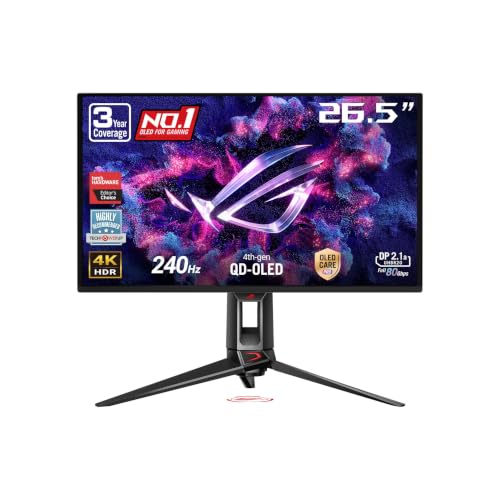
ASUS ROG PG27UCDM 27 Inch 4K 240Hz OLED Gaming Monitor

AOC 27 Gaming Monitor QHD 240Hz QD OLED G-SYNC Compatible Q27GAZD
More Details On Our Top Picks
This Dell moves away from the OLED-heavy theme and gives you a steadier IPS panel, which suits long desk sessions and mixed use. The 4K resolution, 120Hz refresh rate, and 5ms response time make it a cleaner fit for productivity-heavy setups that still see some gaming after hours.
Anti-glare coating helps in bright rooms, and the stand adjusts for height, swivel, and pivot, so you can keep the screen aligned without piling books under it. The trade-off is simpler contrast than the OLED models below, but the 99% sRGB coverage and USB-C input make it a sensible all-rounder.
What We Like
- 4K at 120Hz gives you crisp text and smoother motion than a standard office panel.
- IPS construction keeps viewing angles broad, which helps in a shared desk or dual-monitor setup.
- USB-C plus HDMI and DisplayPort cover a wide spread of laptops and desktops.
- Height, swivel, and pivot adjustment make daily positioning easier than a fixed stand.
Points To Note
- IPS contrast stays flatter than OLED, so dark scenes won’t have the same depth.
- 5ms response time is fine for general gaming, though faster panel tech exists in this list.
- The brighter-room finish helps with reflections, but it still needs decent desk lighting control for the cleanest image.
Feature Rundown
Who Should Grab It
It suits you best if your desk sees equal parts work, browsing, and lighter gaming, and you want 4K clarity without leaning into OLED maintenance concerns.
Swap It Out When
ASUS ROG PG27UCDM is a stronger fit for a gaming-first setup that wants 4K OLED speed and more advanced panel care features.
The glossy OLED finish gives this ASUS a different personality from the Dell, with deeper perceived contrast and a punchier look in controlled lighting. At 1440p rather than 4K, it asks less of your graphics card, which can matter more than raw pixel count for long gaming sessions.
Custom heatsink and anti-flicker support speak to comfort over time, and the uniform brightness feature helps keep the image more even across mixed content. The honest read is that glossy screens can be gorgeous in the right room, but they’re less forgiving near windows or harsh lamps.
Strong Points
- 240Hz refresh rate keeps fast motion fluid for competitive play.
- 0.03ms response time helps cut visible blur in rapid movement.
- Glossy OLED styling gives color and contrast a vivid, high-impact look.
- Anti-flicker and uniform brightness are useful touches for longer sessions.
- PS5 and Xbox support broadens its appeal for console-heavy setups.
Small Caveats
- The glossy surface can catch reflections in bright rooms.
- 1440p keeps frame rates friendlier than 4K, but it also gives you less desktop space than the Dell or Samsung 4K picks.
- That vivid OLED look may feel too strong for users who prefer a softer, office-style image.
Details At A Glance
Built With In Mind
You’ll like this most for a gaming station in a dim room, especially one that leans toward console play and fast-paced PC titles.
Where A Sibling Pick Shines
LG 27GX704A-B is the easier fit for someone who wants a broader mix of HDR support and both NVIDIA and AMD sync compatibility in a black chassis.
LG gives you a very complete gaming spec sheet without jumping to 4K, and that can be a smart trade in a fast-paced setup. The 240Hz panel, 0.03ms response time, and HDMI 2.1 support make it feel built for people who split time between PC and console.
The HDR True Black 400 label points to OLED-friendly contrast for dark scenes, while the black finish keeps the overall look understated compared with the flashier ASUS model above. One thing worth considering is that 1440p still has less desktop room than 4K, but many gamers will prefer the lighter GPU load.
Upsides
- HDMI 2.1 helps modern consoles and newer PCs keep up with the panel.
- G-Sync and FreeSync Premium Pro support broaden compatibility across graphics setups.
- OLED contrast suits dark scenes, late-night sessions, and cinematic game art.
- 240Hz keeps the image responsive for twitch-heavy play.
Areas To Watch
- 1440p resolution trades some desktop density for speed and easier GPU demands.
- OLED panels need normal care around static desktop elements, so long-term mixed use deserves some attention.
- The black finish is restrained, which is fine for most desks, but it won’t stand out like the ASUS glossy option.
Core Details
Whose Shelf It Belongs On
This is a solid match for you if gaming is the main job and you’d rather spend system power on frame rate than on 4K detail.
Look Elsewhere When
ASUS ROG PG27UCDM makes more sense for someone who wants 4K resolution, DisplayPort 2.1, and more advanced OLED care in the same class.
This Samsung sits a step below the faster 240Hz models, but the 180Hz QD-OLED panel still lands in a very usable place for most gaming rooms. QD-OLED, meaning quantum dot OLED, uses a color-enhancing layer to push vivid image output, and here that matters more for rich tone than for brute-force speed.
The support package is unusually practical, with setup help, surge coverage, and repair support tied to genuine parts and trained technicians. That matters if you want a monitor that feels less fragile from an ownership standpoint, though the shorter refresh ceiling makes it less aggressive than the LG and ASUS picks above.
Bright Spots
- QD-OLED brings strong contrast and lively color for games and media.
- 180Hz is still smooth for everyday competitive play.
- Response time of 0.03ms keeps motion handling quick.
- Built-in support structure helps with setup and troubleshooting over time.
Minor Gripes
- 180Hz is good, but it does trail the 240Hz models in this list.
- The monitor leans hard toward gaming, so it may not feel as adaptable for mixed office work as the Dell IPS option.
- Samsung service features sound useful, yet they also mean you’re buying into a more branded ownership path.
Feature Card
The Right Fit
You’ll get the most from this in a gaming-first setup where vibrant image quality matters more than chasing the fastest refresh number on the shelf.
A Better Fit Elsewhere
Dell S2725QS suits you better for mixed work and gaming because the IPS panel, USB-C port, and adjustable stand are easier to live with all day.
This Samsung moves up to 4K while keeping the 240Hz ceiling, and that combination is aimed squarely at high-end gaming desks. The ergonomic stand also helps the monitor settle in better than fixed, style-first designs, which matters more than people expect during long sessions.
Compared with the G5 above, this one gives you the sharper 4K canvas, so text and in-game detail both feel more refined. The trade-off is the usual one for this class, because a 4K OLED panel asks a lot of your GPU and makes the rest of the setup work harder too.
Reasons To Buy
- 4K resolution adds sharper detail for gaming and desktop work.
- 240Hz suits very fast motion and high-frame-rate systems.
- 0.03ms response time keeps pixel transitions extremely quick.
- DisplayHDR True Black 400 points to strong OLED contrast behavior.
- Ergonomic stand improves placement flexibility on a crowded desk.
Softer Spots
- 4K at 240Hz pushes more load onto your graphics hardware.
- The premium feature set makes it more specialized than the Dell IPS model or the AOC below.
- OLED ownership still benefits from normal desktop care, especially around static UI elements.
Core Details
Who Will Love This
This belongs on a premium gaming desk where you want 4K sharpness, high refresh speed, and a monitor that feels serious from the stand up.
Another Choice May Suit
LG 27GX704A-B is the better match for someone who wants a simpler route to strong gaming features and doesn’t need the 4K load.
The PG27UCDM feels like the most technical entry in the group, with OLED Care Pro, a Neo Proximity Sensor, and a custom heatsink all aimed at long-term panel management. That matters in a real desk setup because a monitor this capable often sits in the center of everything, from work sessions to late-night gaming.
DisplayPort 2.1 is the headline connector, and that gives this ASUS more headroom than many monitors still relying on older bandwidth. You may find the added protection features reassuring, though the real trade-off is simple, this is a specialist display, not the casual middle-ground choice.
Best Bits
- 4K at 240Hz keeps it in the high-end speed class.
- OLED Care Pro and the proximity sensor show a strong focus on panel management.
- DisplayPort 2.1 gives modern connection headroom.
- True 10-bit color helps with smoother tonal gradation.
- PS5 and Xbox support adds console flexibility.
Room For Improvement
- Its feature depth comes with a more specialized setup style than the Dell.
- OLED maintenance habits still matter, especially for mixed desktop use.
- The advanced feature set makes it overkill for a basic work-first desk.
Technical Sheet
The Right Fit
You should look here if your desk is built around a serious gaming PC and you want the monitor itself to feel as advanced as the rest of the rig.
Where A Sibling Pick Shines
SAMSUNG 27-inch Odyssey QD-OLED G8 makes more sense for someone who wants a premium 4K OLED option with a more straightforward setup story.
AOC closes the list with a leaner QD-OLED setup that keeps the focus on core gaming traits rather than extra frills. The 240Hz refresh rate and 0.03ms response time put it in fast-motion territory, while the 2560 by 1440 resolution stays easier to drive than 4K.
DP 1.4, HDMI 2.0, an earphone output, and VESA mounting support make it practical for compact desks and console setups. Compared with the richer ASUS and Samsung models, this one looks more stripped back, but that’s exactly why it can suit a cleaner, simpler build.
Highlights
- 240Hz and 0.03ms keep the motion profile quick and responsive.
- QHD resolution is easier on graphics hardware than 4K.
- VESA mount support helps with arm setups and tight desks.
- Earphone output and console-ready connections add useful flexibility.
Worth Noting
- HDMI 2.0 and DP 1.4 are more modest than the newer connections on some rivals.
- The 1440p panel gives you less desktop density than a 4K option.
- It feels more utilitarian than the premium ASUS and Samsung choices above.
Core Details
Best Suited To
This is a smart fit for you if you want a gaming monitor with strong basics, a tidy footprint, and fewer extras to manage.
Where Shoppers Go Wrong
Dell S2725QS is the safer path for mixed work and play, while the AOC is aimed more squarely at game-heavy setups.
How To Choose The Right 4k 27 Inch Oled Monitors
Resolution, Refresh, And The Shape Of Your Day
A 27-inch 4K panel gives you a dense image that keeps text crisp and UI elements tidy. That matters for photo work, spreadsheets, and modern games with lots of small interface detail.
Refresh rate matters just as much as resolution once you spend real time scrolling or gaming. A 120Hz IPS screen like the Dell feels calmer for mixed use, while 240Hz OLED models such as the ASUS and LG favor fast movement and lower blur.
OLED, IPS, And Why The Panel Type Changes Everything
OLED brings self-emitting pixels, which means each pixel lights itself and can shut off individually. That creates deeper blacks and stronger contrast, especially in dim rooms, but it also means static desktop habits deserve more care than IPS.
IPS, short for in-plane switching, keeps colors and viewing angles steady without the same burn-in concerns people associate with OLED use. The Dell is the practical choice here for long office-style sessions, while the Samsung and ASUS options suit you better when image pop matters more than desk neutrality.
Console Support, Ports, And Desk Setup
HDMI 2.1 is the important port for current console setups, while DisplayPort is still the safer route for many PC rigs. ASUS PG27UCDM stands out with DisplayPort 2.1, which gives you more modern bandwidth headroom than older connection standards.
Stand adjustment also deserves attention, especially on a 27-inch screen that sits close to your face. Height, swivel, and pivot help you fit the monitor to your posture instead of adapting your posture to the monitor, and that becomes more valuable the longer you sit there.
Match The Monitor To The Room
Bright rooms punish glossy panels more than dim rooms do, so the ASUS glossy OLED makes more sense in controlled lighting. For a shared office or multipurpose desk, the Dell’s anti-glare IPS finish is easier to live with day after day.
A Quick Reality Check
Common Shopping Slip Ups
A lot of people chase 4K and forget to check whether their graphics hardware can keep up at high refresh rates. That’s how a premium panel ends up running below its potential, especially on 240Hz OLED models.
Another mistake is ignoring desk lighting and screen finish. Glossy OLED looks striking in the right room, but a sunlit workspace can make reflections part of the daily routine.
When Paying More Pays Off
Higher-tier models usually charge more for faster panels, better color handling, stronger connection standards, and extra panel-care features. On the ASUS PG27UCDM, that shows up in OLED Care Pro, DisplayPort 2.1, and the Neo Proximity Sensor, all of which support a more advanced ownership experience.
The upgrade makes sense when your monitor sits at the center of a serious gaming setup or a hybrid work-and-play station. For a simpler desk, the Dell or AOC gives you enough capability without pulling you into the top tier.
Frequently Asked Questions
Are 27-inch 4K OLED monitors good for mixed work and gaming?
Yes, they can handle both, but the panel type matters. IPS is easier for all-day office use, while OLED is more appealing for gaming and media.
Does 240Hz matter at 27 inches?
It does for fast games and quick mouse movement. The gain is less about screen size and more about how smooth motion feels.
Is QD-OLED different from regular OLED?
Yes, QD-OLED adds a quantum dot layer that boosts color output. That can make bright, vivid game scenes feel more striking.
Do you need HDMI 2.1 for a console?
HDMI 2.1 is the better match for modern console features and higher-bandwidth signals. HDMI 2.0 still works for many setups, but it is more limited.
What matters more, resolution or refresh rate?
That depends on your use case. For desktop clarity, 4K matters most, while fast gaming often benefits more from a higher refresh rate.
Closing Thoughts
A strong 4k 27 Inch Oled Monitor should match the way you actually sit and play, not just the spec sheet. The Dell makes the most sense for mixed everyday use, while the ASUS and Samsung OLED models push harder for deep contrast and speed. The LG and AOC land in the middle with smart gaming balance. Pick the panel that fits your room, your console or PC, and the hours you’ll spend in front of it.
