
You want sharp text, rich contrast, and motion that doesn’t smear when a game gets hectic or a timeline fills up. A 27-inch 4K OLED monitor can do that well, but the real differences sit in refresh rate, panel type, stand movement, and how each screen handles brightness in a normal room. This roundup keeps the focus on real use, not spec-sheet noise.
You’ll also see where a QHD OLED can make more sense than jumping straight to 4K. That matters for desks, consoles, and PC setups that need the right balance rather than the fanciest label.
Shortlist At A Glance

Dell 27 Monitor S2725QS 4K UHD IPS 120Hz

ASUS ROG XG27AQDMG 27 Inch 1440p 240Hz Glossy OLED Gaming Monitor

LG 27GX704A-B 27-inch Ultragear QHD OLED Gaming Monitor 240Hz
Samsung 27” Odyssey OLED G5 (G50SF) Series QHD & QD-OLED Gaming Monitor

ASUS ROG PG32UCDP 32 Inch 4K 240Hz OLED Gaming Monitor
SAMSUNG 27-inch Odyssey QD-OLED G8 (G81SF) 4K Gaming Monitor
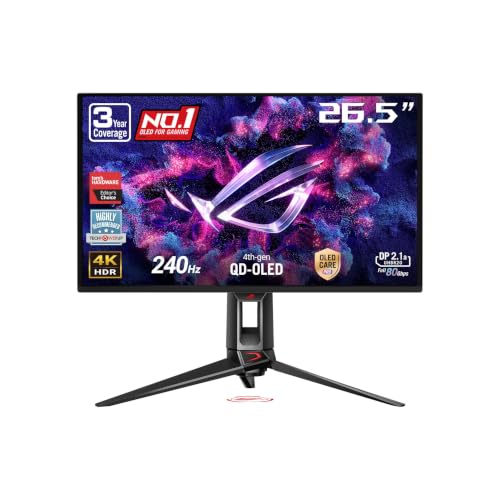
ASUS ROG PG27UCDM 27 Inch 4K 240Hz OLED Gaming Monitor QD-OLED
More Details On Our Top Picks
Dell’s S2725QS leans practical first, which suits a desk that handles work by day and games at night. The IPS panel keeps the picture stable from the side, and the 120Hz refresh rate gives you smoother motion than a standard office screen without pushing into elite-gaming territory.
The height-adjustable stand, swivel, and pivot support make it easier to fit into shared spaces or tighter desks, and the USB-C, HDMI, and DisplayPort inputs cover common setups. The honest read is that it’s less dramatic than the OLED picks, but that also means less fuss for everyday use.
Strong Points
- 4K resolution gives you crisp text and plenty of room for side-by-side windows.
- 120Hz motion feels more fluid than typical office displays, which helps in casual gaming and scrolling.
- USB-C plus HDMI and DisplayPort make it easy to move between laptops and desktops.
- The adjustable stand helps you set a healthier line of sight on a standard desk.
Things To Consider
- It uses IPS, so contrast will not match the deeper blacks of the OLED models in this list.
- The 5ms response time is fine for mixed use, though speed-focused gamers will notice faster panels elsewhere.
- Anti-glare helps in bright rooms, but strong window light can still make any screen work harder.
Feature Snapshot
Who It Suits Best
You get the most from this one if you want a single monitor for schoolwork, office tasks, and occasional gaming on a normal desk.
A Better Fit Elsewhere
ASUS ROG XG27AQDMG fits competitive gaming setups more closely, since its glossy OLED panel and 240Hz refresh rate are built for faster motion.
Compared with the Dell, this ASUS shifts hard toward fast-paced gaming, and the glossy WOLED panel gives the image a punchier look in a controlled room. The 240Hz refresh rate and 0.03ms response time are the sort of specs you notice in twitchy shooters, where motion clarity matters more than desktop flexibility.
The custom heatsink and anti-flicker features point toward longer sessions with less visual strain from panel behavior, though glossy screens do ask more from your lighting setup. For most gaming desks, that trade is worth it, especially when you want OLED contrast without jumping to a larger 32-inch shell.
What We Like
- 240Hz suits fast competitive play and keeps motion feeling immediate.
- OLED contrast gives dark scenes real depth, which helps in story games and night maps.
- The 0.03ms response time supports cleaner motion during quick camera swings.
- Uniform brightness is helpful for mixed content, so menus and game scenes stay more even.
- Console support is a nice touch for anyone splitting time between PC and living-room gear.
Worth Noting
- Glossy finishes can show room reflections more easily than matte panels.
- QHD is easier to drive than 4K, but you give up some desktop detail.
- OLED care still matters in long static-work sessions, even with built-in protections.
Core Details
Right Fit For
You’ll like this most if your desk leans toward esports play, fast action games, and a darker room with controlled lighting.
Swap It Out When
LG 27GX704A-B makes more sense for a user who wants a similar speed profile but prefers the cleaner look of a different QHD OLED option.
The LG lands in a similar speed class to the ASUS above, but it adds a different mix of gaming-friendly extras that make it feel especially tuned for a bright, modern setup. The DisplayHDR True Black 400 rating points to deeper OLED-style shadow handling, which helps in games with dark corridors or moody scenery.
HDMI 2.1 is the practical detail that matters for console owners and newer graphics cards, while the 240Hz panel still keeps the monitor firmly in fast-motion territory. You may find the black finish and QHD resolution easier to live with than a 4K panel on midrange hardware, which is a sensible trade, not a compromise to feel bad about.
Upsides
- 240Hz refresh and 0.03ms response support very quick on-screen action.
- DisplayHDR True Black 400 suits scenes where shadow detail matters.
- HDMI 2.1 broadens compatibility with current consoles and newer PCs.
- G-Sync Compatible and FreeSync Premium Pro help reduce tearing across different systems.
Room For Improvement
- QHD is a smart match for speed, but it won’t match the pixel density of the 4K options.
- The panel still asks for some caution around long static desktop layouts, as OLED screens generally do.
Details At A Glance
Best Suited To
You’ll get the most from this monitor if you play fast games, use a modern console, or want a strong OLED screen without chasing 4K.
Consider Something Else When
Samsung 27” Odyssey OLED G5 is a better fit for a shopper who wants a slightly different feature mix and an ergonomic stand in the same general class.
Samsung takes a slightly different path here, slowing the refresh rate compared with the 240Hz picks while keeping the OLED picture quality front and center. That makes it more of a refined all-round gaming screen than a pure speed machine, which fits a lot of mixed PC and console setups.
The QD-OLED panel should appeal to anyone who cares about saturated color and strong contrast, while the ergonomic stand makes placement easier on a cramped desk. The trade-off is simple: you give up some top-end motion speed, but you gain a calmer, more flexible daily setup.
Highlights
- QD-OLED should deliver rich color and deep contrast for games and streaming.
- The ergonomic stand makes height and angle adjustments easier in shared spaces.
- 180Hz is still smooth enough for many action games and racing titles.
- The 0.03ms response time keeps motion handling in the fast class.
Small Caveats
- 180Hz trails the 240Hz models in this roundup, so the fastest players may want more headroom.
- QD-OLED screens usually reward careful dusting and a tidy desk because glossy surfaces show smudges more readily.
- The product page leans heavily into support and service details, so setup-minded users may care more about the overall package than the panel alone.
Feature Card
The Right Fit
This suits you best if you want vivid OLED image quality, a flexible stand, and gaming performance that is strong without being hyper-focused on esports speed.
Where A Sibling Pick Shines
ASUS ROG XG27AQDMG is the stronger match for a speed-first desktop, thanks to its 240Hz panel and glossy WOLED tuning.
The 32-inch size changes the feel right away, giving you more room for a 4K desktop, a larger game view, and side-by-side work windows. Dual mode is the standout here: you can use 4K at 240Hz for clarity or switch to FHD at 480Hz for the kind of speed that matters in very fast games.
That flexibility makes it the most adaptable pick in the group, though the larger footprint means you need more desk depth than you would with the 27-inch screens. For mixed work and play, it has a rare kind of reach, like a monitor that can stretch to fit the day instead of forcing one lane.
Best Bits
- Dual mode lets you choose between sharper 4K detail and extreme refresh speed.
- The 32-inch panel gives you more usable space for creative work and multitasking.
- USB-C 90W helps simplify laptop hookups for desk setups that change often.
- True 10-bit color supports smoother tonal transitions in media and content work.
- The custom heatsink is a useful clue for long gaming sessions and OLED management.
Points To Note
- The larger size needs more space, so compact desks may feel crowded.
- Its feature set is rich enough that casual users may pay for flexibility they never use.
- As with other OLED panels, a varied mix of content is the wiser everyday pattern.
Technical Sheet
Built With In Mind
You should look here if you want a bigger OLED screen that can handle both detailed 4K work and very fast gaming.
Another Choice May Suit
Dell 27 Monitor S2725QS is a calmer match for mixed office use and smaller desks, especially when you want a simpler setup.
This Samsung feels like the polished middle ground between the pure speed monitors and the more office-friendly 4K screens. The 240Hz refresh rate keeps it in serious gaming territory, while the DisplayHDR True Black 400 label suggests the kind of shadow control OLED fans usually look for.
Its ergonomic stand is the quiet advantage, especially on desks where height and tilt matter as much as pixel count. The trade-off is that it leans into premium positioning without trying to be the most specialized screen in the group, which suits many setups better than an extreme one-trick design.
Bright Spots
- 4K detail on a 27-inch panel gives you dense, crisp image quality.
- 240Hz and 0.03ms keep gaming motion very responsive.
- DisplayHDR True Black 400 points to strong dark-scene performance.
- The ergonomic stand helps you fit the monitor neatly into a long workday setup.
Softer Spots
- Its premium focus may be more screen than a casual office user really needs.
- With OLED, a varied mix of content and a tidy panel surface usually make ownership feel easier.
Core Details
Whose Shelf It Belongs On
This belongs on the desk of a gamer who wants 4K clarity, very fast motion, and a stand that makes daily setup easier.
Skip It When
ASUS ROG PG27UCDM is the better fit for anyone who wants smarter OLED care features and a more feature-forward 27-inch 4K option.
This ASUS is the most forward-looking 27-inch 4K option in the group, mostly because it pairs top-tier refresh speed with extra care features that matter over a long ownership stretch. The Neo Proximity Sensor is the unusual detail here, since it helps the monitor react when you step away, which is useful for desks that see long breaks between sessions.
DisplayPort 2.1, the custom heatsink, and the OLED Care Pro suite make this feel aimed at careful enthusiasts rather than casual spec shoppers. It is a strong fit for a high-end PC desk where you want sharp text, deep contrast, and fewer worries about keeping an OLED panel in good shape.
Best Bits
- 4K at 240Hz gives you both detail and speed in one panel.
- The Neo Proximity Sensor adds a thoughtful layer for OLED ownership.
- DisplayPort 2.1 supports high-bandwidth PC setups.
- True 10-bit color is useful for smooth gradients and media work.
- The custom heatsink supports steady performance over long sessions.
Areas To Watch
- The feature set is deep, so casual users may pay for extras they never touch.
- OLED still rewards sensible desktop habits, especially with static toolbars and repeated UI elements.
- The monitor is clearly built for a premium desk, so simple setups may feel underpowered for its level.
Feature Rundown
Who Should Grab It
You should choose this if you want a premium 27-inch 4K OLED with smart protection features and a very strong gaming spec sheet.
Look Elsewhere When
Samsung 27-inch Odyssey QD-OLED G8 makes more sense for someone who wants a similar premium feel with a different stand and brand tuning.
What To Weigh Before Choosing Your 4k Oled Monitor 27 Inches
Mistakes Worth Dodging
Panel type matters, but so does the rest of the chain. A 4K OLED screen can still feel wrong on a desk that has too little depth, poor lighting control, or a graphics card that struggles to keep pace.
Refresh rate is another easy trap. A 240Hz monitor sounds better on paper, yet a mixed-use desk may get more value from 120Hz or a strong QHD OLED that leaves room for other parts of the system.
The Case For Spending Up
Higher-tier models usually pay for deeper color tech, faster response, better cooling, and more careful OLED management. Those extras matter most in rooms where you game often, keep a monitor for years, or split time between play, creative work, and heavy multitasking.
That upgrade also tends to buy better stands, stronger connectivity, and more comfort features. In plain terms, you’re paying for a screen that asks less of your day and more of your hardware.
Frequently Asked Questions
Is 4K worth it on a 27-inch monitor?
Yes, especially for sharp text, detailed UI work, and story-heavy games. The denser pixel layout makes the screen feel clean without needing a larger desk.
Does OLED make sense for everyday office use?
It can, but the best fit depends on how static your workday is. If your screen stays on the same layout for many hours, a careful mix of tasks and a model with stronger care features is the smarter path.
Why do some 27-inch options use QHD instead of 4K?
QHD lowers the load on your graphics hardware and often makes very high refresh rates easier to sustain. That trade can feel wise for fast gaming, even if 4K looks sharper on paper.
What matters more, refresh rate or response time?
They work together, but refresh rate changes the overall motion feel more often in day-to-day use. Response time helps keep fast transitions cleaner so the higher refresh can actually show its advantage.
Are glossy OLED screens a bad idea in bright rooms?
Not always, but reflections become more noticeable when windows or lamps sit behind you. A matte or anti-glare finish is usually easier in bright spaces, while glossy panels look best in controlled lighting.
