
You want a screen that fits a desk without feeling cramped, keeps motion clean in fast games, and still handles everyday work after the match ends. That’s the practical middle ground this roundup targets. You’ll see a mix of higher-refresh IPS panels, one curved option for a more enveloping view, and a few models that lean into extra comfort features like speakers, height adjustment, or wider color coverage.
Quick Look At Our Top Picks

KTC H24T7 24 Inch Gaming Monitor 180Hz 1440P Fast IPS

LG 24G411A-B 24-inch Ultragear Full HD IPS Gaming Monitor

Dell 24 Plus Monitor S2425HSM 23.8-inch FHD 144Hz

msi PRO MP243L E14 24-inch IPS 1080p Gaming Office Monitor

Sceptre Curved 24-inch Gaming Monitor 1ms 100Hz 1500R

Dell 24 240Hz Gaming Monitor SE2426HG 23.8-inch FHD
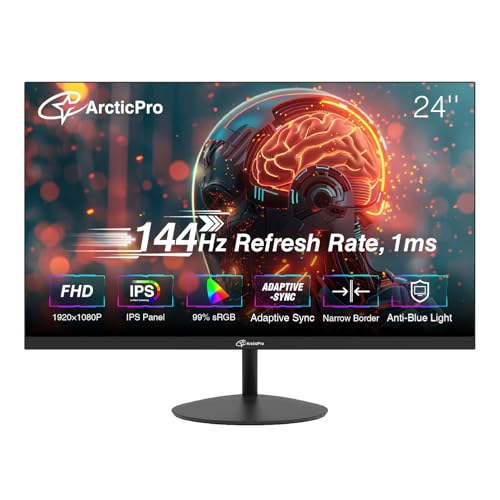
ArcticPro 24 Inch Gaming Monitor 144Hz FHD IPS
More Details On Our Top Picks
The KTC H24T7 leans into sharpness first, with a 1440p panel on a 24-inch frame and Fast IPS for broad viewing angles. That mix matters on a compact desk because text stays crisp for work hours, then motion stays cleaner once you switch into games. The height, tilt, pivot, and VESA mount support make it flexible in a cramped setup.
The trade-off is straightforward: a higher-resolution panel asks more from your graphics card than a plain 1080p screen. You may find that a vertical setup is handy for browsing, coding, or side-panel apps, but it’s less about raw speed than the 240Hz Dell later in this list.
Strong Points
- 1440p on 24 inches gives you a denser, cleaner image than basic Full HD.
- Fast IPS helps keep color and viewing angles consistent across the desk.
- Adaptive Sync support reduces tearing in games that swing between frame rates.
- Height, tilt, and pivot adjustment help you set a safer, more natural viewing position.
- VESA mounting gives you more options for arm setups and tight workstations.
Things To Consider
- 1440p can make sense only when your GPU can keep up comfortably.
- HDR 400 is useful as a feature callout, but it is not in the same lane as premium HDR implementations.
- A vertical layout suits side tasks more than wide, cinematic gaming sessions.
Feature Snapshot
Who It Suits Best
Serious multitaskers and gamers with a compact setup benefit most from this mix of sharpness and stand flexibility.
Where A Sibling Pick Shines
Dell 24 240Hz Gaming Monitor SE2426HG suits you better if frame rate smoothness matters more than extra pixel density.
LG keeps this one focused on the familiar 24-inch 1080p formula, then adds a fast IPS panel, 144Hz overclocking, and 1ms MBR, which stands for motion blur reduction. In plain terms, that combination is built for cleaner movement in shooters and action games without asking you to juggle a higher-resolution load. The slim stand also helps on shallow desks.
Compared with the KTC, you give up the extra pixel density but gain a more straightforward setup for mainstream gaming PCs and consoles. The honest read is that this will feel natural for most people who want speed first, not a display that asks for a beefy graphics card.
What We Like
- 144Hz overclocking keeps the motion spec firmly in gaming territory.
- IPS technology gives you stable color and viewing angles across the screen.
- 1ms MBR is aimed at reducing blur in fast scenes.
- NVIDIA G-Sync Compatible and AMD FreeSync support make it friendlier across different graphics setups.
- HDMI and DisplayPort inputs cover common desktop and console hookups.
Worth Noting
- 1080p at 24 inches is practical, though less detailed than the KTC’s 1440p panel.
- Overclocked refresh support depends on the source device and connection settings.
- The slim stand is tidy, yet it leaves less room for built-in adjustability than Dell’s more flexible option below.
Core Details
Built With In Mind
This suits you best if you want a fast 1080p screen for competitive play on a normal desk.
A Better Fit Elsewhere
Choose the Dell 24 240Hz Gaming Monitor SE2426HG instead when your priority is the highest refresh rate in this group.
Dell gives you a more lifestyle-friendly spin on the 24-inch gaming monitor formula, with 2 x 3W speakers and a stand that moves through height, tilt, pivot, and swivel. That makes it useful in a bedroom setup, a small office, or a shared desk where external speakers would just add clutter. The Ash White finish also stands apart from the usual black shells.
It sits closer to the LG than the KTC on resolution, but the added stand movement makes daily positioning easier. You may find the built-in speakers handy for basic use, though dedicated audio gear still makes more sense for games and music.
Bright Spots
- Height, tilt, pivot, and swivel adjustment give you rare flexibility at this size.
- Built-in speakers reduce desk clutter for casual play and everyday media.
- 144Hz and 1ms keep the panel in the expected gaming range.
- AMD FreeSync support helps with smoother frame pacing on compatible systems.
Areas To Watch
- Built-in speakers are convenient, but they rarely replace a proper headset or desktop audio setup.
- The 23.8-inch panel is slightly smaller than the other 24-inch class choices here.
- A white finish can show dust more readily than darker frames.
Details At A Glance
Who Will Love This
You get the most from this Dell if you want a tidy all-purpose display with useful stand movement and no extra speaker box.
Another Choice May Suit
LG 24G411A-B makes more sense if you want a simpler black gaming look and do not need the extra stand articulation.
MSI pushes this model toward the desk that has to do double duty, and that makes sense for dorms, shared workstations, or a home office that sees evening gaming. The 4-side slim bezel keeps the frame visually light, and the VESA mount support makes it easier to move onto an arm. HDMI and VGA both matter here, especially for older hardware.
Compared with the Dell and LG options, this one looks more like a utility-first screen than a style piece. The honest read is that it covers the basics well, though the 1080p panel and 144Hz ceiling keep it in the mainstream lane rather than the enthusiast lane.
Upsides
- 144Hz and 1ms keep it aligned with fast 24-inch gaming expectations.
- FreeSync support helps smooth out frame-rate shifts on compatible systems.
- VESA mountability makes desk planning easier when space is tight.
- The slim bezel design works well in multi-monitor layouts.
- HDMI plus VGA makes older and newer devices easier to connect.
Points To Note
- The feature set is practical, not flashy, so style-first setups may want more polish.
- VGA is useful for legacy gear, but many modern setups won’t need it.
- Ownership stays simple, though the plain black finish can look utilitarian next to Dell’s Ash White frame.
Feature Card
The Right Fit
You should look here for a straightforward monitor that can handle work by day and gaming by night without much fuss.
Swap It Out When
KTC H24T7 suits you better if a sharper 1440p image matters more than legacy input flexibility.
Sceptre takes a different route from the flat panels above by using a 1500R curve, a radius that wraps the screen more tightly around your field of view. For long sessions on a modest desk, that can feel more relaxed than a flat panel, especially once you add the built-in speakers and dual HDMI inputs. It’s a familiar-shaped display, a little like a concave window that keeps the action centered without visual clutter.
The trade-off is refresh rate, since 100Hz sits below the 144Hz and 240Hz options in this list. That makes it a better fit for casual gaming, mixed use, and color-sensitive content thanks to the 100% sRGB claim, rather than fast esports-first play.
Positives
- The 1500R curve can feel more immersive at a close desk distance.
- 100% sRGB is useful for color-aware everyday work and content.
- Built-in speakers keep the setup simpler for secondary rooms.
- Two HDMI ports make it easier to leave multiple devices connected.
Softer Spots
- 100Hz is fine for casual play, though it trails the faster monitors here.
- The curved shape suits personal gaming use more than strict office symmetry.
- Built-in audio is convenient, but a headset or separate speakers still gives you more control.
Feature Rundown
Best Suited To
This fits you well if you want a curved screen for casual gaming, streaming, and general desk use.
Look Elsewhere When
LG 24G411A-B is the cleaner choice if your priority is a faster 144Hz flat panel for competitive play.
This Dell is the speed-focused option in the group, and the 240Hz refresh rate is the headline feature because it targets very fluid motion in fast shooters and racing games. IPS technology keeps the image stable across angle changes, while the dual HDMI ports and DisplayPort 1.4 make everyday hookups easy. TÜV 3-Star appears in the listing as well, which signals a comfort-oriented design approach without turning the monitor into a feature overload.
Compared with the LG and MSI, the jump to 240Hz is the main reason to look here. The catch is simple, you’ll benefit most when your PC can produce high frame rates consistently, otherwise the extra refresh headroom sits underused.
Highlights
- 240Hz gives you the highest refresh rate in this roundup.
- IPS technology helps preserve viewing quality across angle shifts.
- Two HDMI ports plus DisplayPort 1.4 cover common source setups.
- Tilt adjustment keeps the stand simple and easy to position.
Small Caveats
- The 23.8-inch size is compact, so some users will want more screen area for multitasking.
- 240Hz makes the most sense with capable hardware and matching game settings.
- The stand only tilts, so you lose the fine positioning found on the Dell 24 Plus above.
Quick Facts
Made For
You should put this on the short list if your main focus is competitive gaming and your PC can support high frame rates.
Another Choice May Suit
KTC H24T7 makes more sense if you want higher resolution at the cost of some refresh rate headroom.
ArcticPro leans into the value end of the category without feeling stripped bare, thanks to 144Hz, IPS, Adaptive Sync, and 110% sRGB. Those parts matter together because you get smooth motion, reliable viewing angles, and color coverage that should feel more lively than a basic office panel. The three-sided frameless design also helps it look cleaner in a dual-monitor layout.
Compared with the Sceptre curve, this one stays flat and more predictable for desk work, while the Dell 240Hz model still owns the speed crown. You may find the anti-blue-light design useful for long evening sessions, though it’s better treated as a comfort feature than a reason to overstate the monitor’s role.
Best Bits
- 144Hz gives you a solid gaming refresh rate without jumping into higher-cost territory.
- 110% sRGB suggests stronger color breadth than a bare-bones panel.
- Adaptive Sync helps reduce stutter and tearing on supported systems.
- The frameless look works well for compact desks and side-by-side displays.
Room For Improvement
- The model name shows a spelling error, which does not affect function but does affect presentation.
- Flat design is practical, though it lacks the wrapped feel of the Sceptre curve.
- Anti-blue-light tuning can be useful for comfort, but it is still worth pairing with sane brightness settings.
Feature Snapshot
Whose Shelf It Belongs On
This fits you well if you want a budget-aware gaming display with better color and a clean frame.
Reach For A Different Pick When
LG 24G411A-B makes more sense if you want a more established gaming line and a simpler spec set.
How To Choose The Right 24 Inch Monitors For Gaming
Refresh Rate First, Then Resolution
A 24-inch gaming monitor lives or dies on motion smoothness and pixel density. A 144Hz panel suits most gaming setups well, while 240Hz makes more sense for fast competitive play and a GPU that can keep pace; 1440p adds crispness but asks more from the graphics card than 1080p. The trade-off is simple, more refresh rate favors motion, more resolution favors detail. Choose the side that matches the games you actually play.
Panel Type And Stand Movement Matter More Than Hype
IPS panels keep color and viewing angles steadier than many older display types, which helps if you sit slightly off-center or share the screen with someone else. Stand adjustments also matter more than they look on paper, because height, tilt, pivot, and swivel can reduce neck strain during long sessions and make a small desk feel less cramped. A fixed stand can still work, but it forces your setup to adapt to the monitor instead of the other way around. That’s fine for a spare room, less fine for a daily-use desk.
Match The Monitor To Your Desk And Hardware
A compact desk often benefits from 23.8-inch or 24-inch screens with slimmer bezels and VESA support. If your graphics card is midrange, a 1080p 144Hz display usually lands in the sweet spot; stronger hardware makes 1440p or 240Hz more realistic. Built-in speakers, extra HDMI ports, or VGA inputs can be useful, but they should follow the main gaming priorities, not replace them. Start with frame rate, image clarity, and ergonomics, then look at the extras.
What To Weigh Before You Choose
Common Shopping Slip Ups
A common mistake is chasing refresh rate without checking whether the rest of the PC can support it. Another is overlooking stand movement, then ending up with a screen that sits too high or too low for daily use. You can avoid both by matching the display to your hardware and your desk height before you look at extras like speakers or curved panels.
The Case For Spending Up
Higher-tier 24-inch gaming monitors usually spend more on sharper panels, faster refresh rates, better stand articulation, and wider port options. That extra money tends to go toward smoother motion, easier positioning, and a more polished daily experience. The upgrade is worth it when you game often, keep the monitor for years, or want a screen that handles work and play without compromise. Casual play on a secondary desk does not always need that jump.
Frequently Asked Questions
Is 24 Inches A Good Size For Gaming?
Yes, 24 inches works well for desks where you sit close to the screen and want quick eye movement across the image. It also keeps most games readable without taking over the room.
Should You Choose 1080p Or 1440p At 24 Inches?
1080p is easier on the graphics card and still looks clean at this size. 1440p gives you more detail, which helps with text clarity and sharper in-game edges.
Does 240Hz Make A Noticeable Difference?
It can, especially in fast competitive games where motion clarity matters. The benefit drops fast if your system cannot deliver high frame rates consistently.
Are Built-In Speakers Worth It?
They are useful for simple setups, guest rooms, or desk setups with little space. Separate speakers or a headset still sound like the better long-term move for most gaming use.
Do Curved 24-Inch Monitors Make Sense?
Yes, but mostly for personal use at a close desk distance. A flat panel still makes more sense for mixed work, shared spaces, or side-by-side monitor layouts.
Final Thoughts
The strongest 24-inch gaming monitor for you depends on how your desk, GPU, and game habits line up. KTC gives you the sharpest blend of resolution and speed, Dell’s 240Hz model leans hardest into motion, and the LG stays easy to recommend for straightforward 1080p gaming. Sceptre, MSI, and ArcticPro fill in the comfort and value angles, while Dell’s 24 Plus adds a more flexible everyday feel. Pick the one that matches your setup, not the one that sounds loudest on the page.
