
Hand strain makes ordinary mouse use feel bigger than it should, especially during long workdays, school sessions, or late-night editing. A vertical shape, a softer click, or even a wrist-rest mouse pad can take some pressure off the hand position you keep repeating all day. These eight picks cover compact wireless models, multi-device setups, and a support pad for anyone who wants a gentler desk setup without overcomplicating things.
The Shortlist At A Glance

KYSONA Ergonomic Wireless Vertical Mouse
KYSONA EM18 Wireless Ergonomic Vertical Mouse

Ergonomic Mouse Pad Wrist Rest Support

Anker 2.4G Wireless Ergonomic Mouse
Lekvey Ergonomic Wireless Mouse

Lekvey Ergonomic Rechargeable Vertical Mouse

Logitech Lift Vertical Ergonomic Wireless Mouse

TECKNET Ergonomic 4800 DPI Vertical Mouse
More Details On Our Top Picks
This KYSONA model combines a vertical body with Bluetooth and 2.4G wireless, so you can keep a cleaner desk while moving between a laptop, desktop, or tablet. The five DPI levels matter because pointer speed can feel too twitchy or too slow on different screens, and the silent switch design suits shared spaces better than a clickier shell.
You may find the purple finish a nice change from the usual black office look, though color is hardly the main reason to consider it. For daily work in a home office or a dorm desk, it looks like a practical middle ground between simple wireless mice and more expensive ergonomic options.
What We Like
- Bluetooth and 2.4G give you setup flexibility across devices.
- Five DPI levels help match speed to different screens and tasks.
- Silent switches suit shared offices, study spaces, and late-night work.
- Vertical shaping encourages a more natural hand position than flat mice.
Points To Note
- The right-hand vertical shape will not suit left-handed use.
- Wireless convenience means you still need to keep track of battery or charging needs, depending on how you set it up.
- Vertical mice usually take a short adjustment period, so the first day rarely feels like the final feel.
Feature Snapshot
Who It Suits Best
You are the best match here if you want a vertical mouse that stays flexible across a laptop, desktop, and tablet without getting fussy.
Where A Sibling Pick Shines
Logitech Lift Vertical Ergonomic Wireless Mouse suits you better if you want a more polished feel and customizable controls for a primary workstation.
The EM18 keeps the same vertical ergonomic idea as the first KYSONA pick, but the listing is more explicit about medium and large hands. That detail matters in real use, because a mouse that sits too small can leave your fingers crowded and your grip more tense than it needs to be.
Silent click behavior and 5-level DPI make it a sensible desktop companion for long document sessions, spreadsheet work, or web-heavy days. The pink finish gives it a softer look, though the real draw is the hand-size guidance, which takes some guesswork out of shopping.
Reasons To Buy
- Medium and large hand guidance helps narrow the fit.
- Vertical posture can feel less cramped than a flat mouse.
- Silent clicking works well in open offices and shared rooms.
- Five DPI settings give you more control over pointer speed.
Areas To Watch
- Smaller hands may find the shape a bit roomy.
- Pink styling is personal, so it may not suit every desk setup.
- As with most vertical mice, the first few days can feel unfamiliar.
Core Details
Made For
You will get the most from this one if you know your hands need a larger vertical shell and you want a soft-click option for routine desk work.
Look Elsewhere When
KYSONA Ergonomic Wireless Vertical Mouse makes more sense for you if you want Bluetooth plus 2.4G flexibility for swapping across more than one device.
This is the one item here that changes the desk surface instead of the mouse shape, and that matters more than it sounds. The memory foam wrist rest gives your hand a softer landing zone, while the massage-style top is meant to add texture under the wrist during long pointer sessions.
That kind of support makes the most sense beside a wired or wireless mouse that already feels decent but needs a little help at the desk edge. Compared with the vertical options above, it keeps your familiar mouse in play and focuses on cushioning rather than posture changes.
Highlights
- Memory foam adds softer contact at the wrist.
- Non-slip PU base helps keep the pad from sliding around.
- The support format pairs easily with an existing mouse.
- Simple desk placement makes setup nearly effortless.
Small Caveats
- It supports the wrist, but it does not change mouse grip angle.
- The textured surface may feel different from a plain pad.
- Desk users need enough space for both the pad and the mouse path.
Details At A Glance
Right Fit For
You are the best match if your current mouse feels fine, but your wrist wants more support at the desk edge.
Another Choice May Suit
Lekvey Ergonomic Mouse, Rechargeable Vertical Wireless Mouse fits you better if you want a full hand-position change instead of a support pad.
Anker keeps things familiar here: a right-hand vertical shape, a USB receiver, and a five-button layout that makes the transition from a standard mouse less jarring. The 800, 1200, and 1600 DPI levels cover the basics well, so you can keep pointer movement calm for spreadsheets or faster for general browsing.
This pick stands out more for straightforward use than for flair, and that suits desktop work where you want something plain and dependable. You do need batteries, which is the trade-off for a simple wireless setup, but that also means no charging cable to manage.
Upsides
- Right-hand vertical form can ease the switch from a flat mouse.
- Three DPI levels cover basic office and browsing needs.
- USB receiver connection keeps setup simple on a laptop or desktop.
- Five buttons give you more control than a bare-bones mouse.
Room For Improvement
- Batteries are required, so upkeep is less simple than recharge-first models.
- The shape suits right-handed use only.
- It offers fewer sensitivity steps than some newer picks here.
Quick Facts
Whose Shelf It Belongs On
You will appreciate this if you want an uncomplicated right-hand vertical mouse for a Windows or Mac desk and you do not mind batteries.
Swap It Out When
Logitech Lift Vertical Ergonomic Wireless Mouse is the stronger match for you if you want a more polished premium feel and customizable buttons.
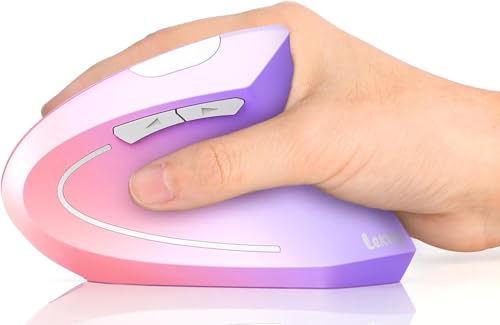
This Lekvey version brings the same general vertical comfort idea, but the rechargeable build and pink-purple finish give it a more personal feel on a home desk. USB-C charging is a nice practical touch, because it fits the same cable habit many people already have for other devices.
The 800, 1200, and 1600 DPI settings cover normal office work well, and the quiet click design helps in shared spaces or evening use. The honest read is that it leans more toward comfort plus style than pure feature depth, which is fine for most everyday setups.
Best Bits
- Rechargeable design removes the need to keep spare batteries around.
- USB-C charging is convenient for modern desk setups.
- Quiet clicks make it more suitable for shared environments.
- Three DPI steps are enough for common office tasks.
Honest Caveats
- The color choice is personal, so it will not suit every workspace.
- Three DPI levels are useful, though not as flexible as higher-tier options.
- The vertical learning curve still applies during the first stretch of use.
Feature Rundown
The Right Fit
You are a good match here if you want a recharge-first vertical mouse with a friendlier look for a personal desk or study space.
Where A Sibling Pick Shines
Lekvey Ergonomic Rechargeable Vertical Mouse suits you better if you want the same core comfort idea with a more neutral finish.
This is the older Lekvey model, and the shape still makes sense for anyone who spends long stretches at a laptop or desktop. It adds page-back and page-forward buttons, which save a little reaching during browsing and document work, and the 800, 1200, 1600 DPI range is enough for steady day-to-day control.
The rechargeable battery and nano USB receiver keep the setup lean, with no Bluetooth pairing to sort out. One thing worth considering, though, is that the company notes a short adjustment period, so the comfort payoff tends to come after your hand adapts to the vertical angle.
Strong Points
- Rechargeable design keeps maintenance lighter than battery-swapping models.
- Page-back and page-forward buttons help with web browsing.
- Three DPI levels cover common work speeds without clutter.
- Nano receiver setup keeps the connection straightforward.
- Wide Windows and Mac support broadens its desktop appeal.
Softer Spots
- The hand adjustment period is real for many vertical mice.
- It relies on a USB receiver rather than Bluetooth.
- The feature set is practical, not especially flashy.
Core Details
Built With In Mind
You will like this most if you want a straightforward rechargeable vertical mouse for regular computer work and page-heavy browsing.
Reach For A Different Pick When
Logitech Lift Vertical Ergonomic Wireless Mouse fits you better if you want a more refined control layout and a more premium-feeling desk companion.
Logitech’s Lift sits in the more polished part of this list, with Bluetooth, a Logi Bolt USB-A receiver, quiet clicks, and six buttons that can be customized in part. That matters for anyone who wants to map common actions to reduce extra movement during long work sessions, especially on a main workstation.
Compared with the simpler Anker and Lekvey options, this one feels more feature-aware and less bare-bones. The trade-off is that you are paying for that added polish, so it makes the most sense when the mouse lives at a desk for hours, not just for occasional use.
Bright Spots
- Bluetooth and Logi Bolt receiver support make connection options flexible.
- Quiet clicks keep the desk quieter during long work blocks.
- Four of six buttons are customizable, which adds useful control.
- The vertical layout supports a more relaxed hand position than flat mice.
- Windows and Mac support make it easy to place on a mixed-device desk.
Minor Gripes
- Feature depth adds cost compared with basic vertical mice.
- Custom buttons are handy, though they matter most to frequent desk users.
- The right fit depends on whether you want a more advanced mouse or a simpler one.
Key Specs
Best Suited To
You are the right fit here if you want a more refined ergonomic mouse for daily office work and care about connection flexibility.
Where Shoppers Go Wrong
KYSONA Ergonomic Wireless Vertical Mouse makes more sense if you want a simpler, more budget-friendly wireless path for mixed device use.
TECKNET goes farther than the basic wireless vertical mice here, since it adds 3-device switching, Bluetooth 5.0, and 2.4G support in the same shell. That makes it a strong match for a desk with a laptop, a work PC, and maybe a tablet in the mix, because you can stay in one hand position while moving across devices.
The 4800 DPI ceiling and six DPI levels give you more speed range than the simpler picks in this list, which helps if you jump between detail work and general navigation. The honest trade-off is that the feature set makes sense for busy setups, while a single-device desk may not need this much flexibility.
Standout Traits
- Three-device switching is useful for mixed-device desks.
- Bluetooth 5.0 and 2.4G both broaden connection options.
- 4800 DPI provides a wider speed range than simpler mice here.
- Six buttons can support a more efficient workflow.
- Quiet clicks suit shared workspaces and evening sessions.
Things To Consider
- The extra features make it better for busy desks than minimalist setups.
- Right-handed vertical design keeps the fit specific.
- Battery-powered use means another item to keep an eye on over time.
Feature Card
Who Should Grab It
You are the best match here if your desk work jumps between several devices and you want one mouse to handle all of them cleanly.
Another Choice May Suit
Anker 2.4G Wireless Ergonomic Mouse fits you better if you want a simpler right-hand vertical mouse with fewer moving parts.
What To Weigh Before Choosing Your Mouse
Wrong Turns To Avoid
Shape matters more than a glossy feature list. A vertical mouse can still feel awkward in a too-small shell, and a wrist pad can help only if your current mouse already fits your grip.
Connection type is another easy place to stumble. A Bluetooth option suits a cleaner laptop setup, while a USB receiver can feel more predictable on a desktop with fewer pairing steps.
The Upgrade Payoff
Higher-tier models usually cost more because they bring extra controls, broader device support, quieter switches, or stronger build detail. In this category, those extras pay off for people who spend hours at one desk and want less friction across the day.
Customizable buttons and multi-device switching are the clearest examples. They do not matter much for casual use, but they can save time for anyone who moves between workstations or opens the same tools all day.
Final Thoughts
You have a few different ways to ease desk strain here, and the right one depends on how you actually work. The KYSONA and Lekvey vertical mice make the strongest case for posture change, the Anker keeps things simple, the TECKNET suits multi-device desks, and the wrist rest pad offers the least disruptive shift. Pick the option that matches your hand size, device setup, and tolerance for a short learning curve, and the daily difference can feel more natural than dramatic.
