
Recording a full drum kit or a live band pushes entry-level interfaces to their limits. A 2-channel box simply runs out of inputs by the third microphone. That is where 16-channel audio interfaces earn their place, giving you enough simultaneous capture paths for a full band, a podcast roundtable, or a multi-mic studio session without juggling patch cables or losing takes. The challenge is that not every 16-input device works the same way. Some are standalone digital mixers with USB routing, while others are pure computer interfaces or ADAT expansion units that require a host. Understanding those architectural differences before you commit saves money and frustration.
The Shortlist At A Glance
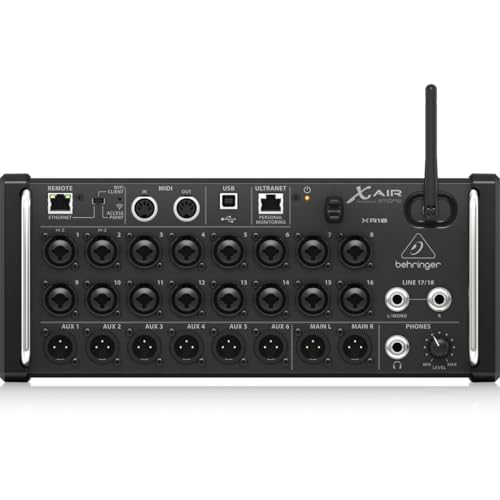
Behringer X AIR XR18 18-Channel Digital Mixer with Midas Preamps
Shure MVX2U Gen 2 XLR-to-USB-C Audio Interface

Behringer ADA8200 ADAT Audio Interface with Midas Mic Preamps
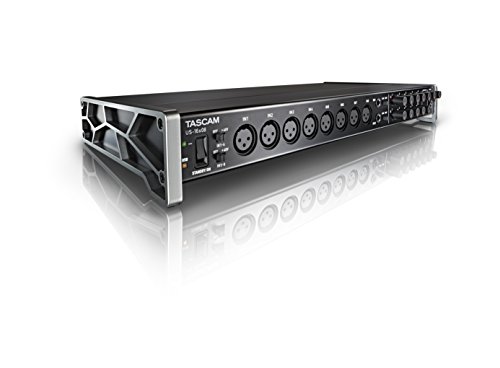
Tascam US-16×08 Rackmount USB Audio/MIDI Interface

Behringer UMC1820 18×20 USB Audio/MIDI Interface with ADAT I/O
More Details On Our Top Picks
The XR18 sits apart from the other picks here because it is a digital stage mixer first and a USB interface second. Sixteen MIDAS-designed preamps handle the front end, and a built-in tri-mode Wi-Fi router lets you walk the room with an iPad or Android tablet to adjust mixes. For a band running its own sound, that wireless control changes the workflow entirely. Instead of being tethered to a FOH position, you tune monitors from the stage while the singer checks their mic. The multi-channel USB audio interface feeds all those channels to a DAW for later mixing, assuming your tablet stays connected and the Wi-Fi signal holds in a crowded venue.
Strong Points
- Sixteen programmable MIDAS preamps deliver clean gain for a full drum kit or band lineup
- Integrated Wi-Fi eliminates the need for an external router at most small gigs
- Tablet control frees the engineer to move around the venue during soundcheck
- Twelve mix buses provide enough sends for a complex in-ear monitor setup
- USB interface captures multitrack recordings straight from the live board
Trade Offs
- Wi-Fi reliability depends heavily on venue congestion; a dedicated router may still be needed in crowded RF environments
- Tablet app dependency means a crashed device halts your mix instantly
- The learning curve for digital routing is steeper than a straightforward USB interface like the Tascam US-16×08
Who It Suits Best
Bands and small venues that need live mixing capability with the bonus of multitrack recording will get the most value from this design.
Where A Sibling Pick Shines
Studio engineers who never need live mixing should consider the Behringer UMC1820, which offers comparable channel count in a dedicated desktop interface.
This Shure unit is the odd one out on this list. The MVX2U Gen 2 handles a single XLR input rather than sixteen, but it earns a spot because it solves a related problem cleanly. For podcasters or voiceover artists who record on the move, lugging a rackmount interface makes no sense. This compact dongle draws power from a USB-C port and provides onboard digital processing to keep levels consistent across different laptops and phones. Compared to the XR18’s stage-ready chassis, this is a pocket-sized tool for one-mic workflows.
Bright Spots
- USB-C bus power means no external supply to carry for remote sessions
- Onboard DSP manages compression and gating so the recorded signal arrives polished
- Mobile-friendly design works with phones and tablets, not just desktops
- Plug-and-play setup gets a mic live in minutes without driver installs
Minor Gripes
- Single-channel capacity rules out multitrack band or drum recordings entirely
- USB-C dependency may require adapters for older USB-A-only machines
Made For
Mobile podcasters and voiceover talent who need polished single-mic capture without a desktop interface will find this fits their travel bag.
Reach For A Different Pick When
Anyone recording a full band should skip this and look at the Behringer UMC1820 for its sixteen-channel simultaneous capture.
The ADA8200 works differently than every other device on this list. ADAT (Alesis Digital Audio Tape) is a light-pipe protocol that carries eight channels of digital audio over a single optical cable. This unit converts eight analog mic signals into that optical stream, meaning it cannot connect to a computer on its own. It needs a host interface with an ADAT input. Owners commonly pair it with the Behringer UMC1820 to add eight extra preamps, hitting that 16-channel mark without buying a second full interface. The eight MIDAS preamps share the same design family as the XR18’s front end, so the sonic character stays consistent across an expanded setup.
Reasons To Buy
- Eight preamps in a 1U rack space keep your rig compact during expansion
- ADAT optical connection adds channels without taxing computer USB bandwidth
- Mic preamp quality matches Behringer’s higher-end interfaces for a uniform signal chain
- Single optical cable run simplifies wiring compared to multichannel analog snakes
Points To Note
- Requires a host interface or recorder with ADAT input; it functions as a companion piece, not a standalone solution
- 24-bit conversion caps at 44.1 or 48 kHz, which may feel limiting for high-sample-rate sessions
- Word clock synchronization can be finicky without careful configuration in multi-unit rigs
Who Will Love This
Studio owners who already have a compatible ADAT-equipped interface and need eight more preamp channels will find this is the most cost-effective path to 16 inputs.
Skip It When
Anyone starting from scratch without a host interface should look at the Tascam US-16×08, which connects directly to a computer over USB.
Unlike the XR18’s wireless mixer architecture, the Tascam US-16×08 is a straightforward USB computer interface built for permanent studio installation. Eight Ultra-HDDA microphone preamps sit on the front panel, delivering up to 56 dB of gain for quiet ribbon mics or demanding dynamic capsules. An additional eight line inputs live on the rear, and two of those switch to instrument level for direct guitar or bass recording. That gives you sixteen simultaneous inputs to your DAW over a single USB cable. The 1U rackmount chassis bolts into a standard studio rack, keeping your desktop clear. For a drummer miking a full kit, those eight front-panel preamps capture every shell and cymbal in one pass.
Upsides
- Rackmount steel chassis survives studio moves better than desktop plastic enclosures
- Eight Ultra-HDDA preamps provide quiet, high-gain capture for low-output microphones
- Two instrument-level inputs let guitarists record direct without a separate DI box
- Eight balanced line outputs feed a hardware mixer or multiple headphone amplifiers
- Included control software handles routing and monitoring without taxing your DAW
Softer Spots
- USB 2.0 connection may show latency on longer cable runs beyond the included length
- No ADAT expansion means you are locked at sixteen inputs with no future channel growth
- Front-panel gain knobs lack precise detents, making exact recall between sessions difficult
Feature Snapshot
Right Fit For
Home and project studio owners who want a self-contained 16-input interface without worrying about ADAT expansion will appreciate this all-in-one approach.
Not Your Match When
Producers planning to scale past sixteen channels should consider the Behringer UMC1820, which includes ADAT ports for future growth.
This is the bridge between the standalone ADA8200 and the self-contained Tascam. The UMC1820 ships with eight MIDAS preamps built in and an ADAT input on the back. Add an ADA8200 via that optical connection and you reach sixteen preamped channels through a single USB cable to your computer. It also carries MIDI, S/PDIF (Sony/Philips Digital Interface, a two-channel digital format), and enough line I/O for a complex hybrid studio. For someone building a growing home studio, starting at eight channels and expanding to sixteen later means you spread the cost over time. The honest read is that the preamp quality matches the XR18’s front end, giving you consistent tone across both units.
Plus Points
- ADAT input allows expansion to sixteen preamp channels without buying a second full interface
- Built-in MIDI ports connect synthesizers and controllers without a separate MIDI interface
- S/PDIF digital I/O handles stereo digital gear like external converters cleanly
- Eight MIDAS preamps deliver ample clean gain for both condenser and dynamic mics
- Rackmount format integrates into a studio rig alongside outboard gear
Small Caveats
- USB 2.0 throughput can bottleneck at high sample rates with all eighteen channels live
- Reaching the full sixteen preamp channels requires a separate ADAT expansion unit purchase
Core Details
Built With In Mind
Growing home studios that want to start at eight channels and expand to sixteen later without replacing their core interface fit this model’s design.
A Better Fit Elsewhere
Engineers who need all sixteen preamps on day one with no expansion hassle should choose the Tascam US-16×08 for its built-in front-panel preamp count.
What Matters Most Before Choosing 16 Channel Audio Interfaces
Connection Type And Host Compatibility
Not every 16-channel device talks to your computer the same way. Pure USB interfaces like the Tascam US-16×08 and Behringer UMC1820 plug directly into a DAW and show up as a single audio device. Digital mixers like the XR18 use USB for multitrack routing but require a tablet app for mixing control. ADAT expansion units like the ADA8200 have no USB port at all and depend entirely on an optical connection to a host interface. Check your computer’s available ports and your DAW’s driver support before committing, since older USB 2.0 interfaces can struggle with latency on longer cable runs.
Preamp Quality And Gain Structure
The preamps built into an interface determine how much clean gain you get before noise becomes a problem. Dynamic and ribbon microphones need higher gain than condensers, and cheap preamps introduce hiss at those levels. MIDAS-designed preamps appear in three of the five picks here, offering consistent headroom for demanding sources. The Tascam’s Ultra-HDDA preamps specify 56 dB of gain, which comfortably drives a Shure SM7B for podcast or vocal work. Match your microphone collection to the preamp specs rather than assuming any interface handles every mic quietly.
Expansion Path And Future Channel Growth
A 16-channel rig can outlive its input count as your studio grows. Interfaces with ADAT ports let you add eight channels at a time through a single optical cable, spreading cost across multiple purchases. The UMC1820 supports this path natively. Devices without ADAT, like the Tascam US-16×08, lock you at their built-in channel count permanently. Consider whether you might need more than sixteen inputs in two years before choosing a non-expandable model.
Things Worth Knowing First
Traps First Timers Fall Into
Many shoppers assume any device labeled “16-channel” connects straight to a computer. ADAT expansion units like the ADA8200 require a host interface, a detail that catches first-time studio builders off guard. Another common misstep is overlooking sample rate limits. A unit capped at 48 kHz may not suit orchestral or high-resolution work. Always confirm the device connects to your recording system independently before adding it to your cart.
When Paying More Pays Off
Higher-tier interfaces add better conversion quality, lower noise floors, and more robust driver support. Spending more typically buys ADAT expansion, MIDI I/O, and dedicated monitoring control. For a studio recording full bands, those extras prevent future replacements. Entry-level gear handles basic sessions well, but the upgrade pays off once your input demands grow.
Frequently Asked Questions
Can a 16-channel interface record a full drum kit with overheads?
Yes, sixteen channels provide enough inputs for a fully miked drum kit. You can assign close mics to individual channels and still have paths left for overheads and room mics.
Do I need a special computer for a 16-channel USB interface?
Most modern computers handle sixteen channels over USB 2.0 without issue. You need sufficient RAM and a fast enough processor to run your DAW plugins alongside the incoming audio streams.
What is ADAT and why does it matter for channel count?
ADAT is an optical protocol that carries eight channels of digital audio through a single cable. It lets you expand an existing interface’s input count without using additional USB bandwidth.
Can I use two of these interfaces at the same time?
Using two independent USB interfaces simultaneously is problematic because computers struggle to sync their clocks. ADAT expansion avoids this by routing everything through one host device.
Do these interfaces work with both Mac and Windows?
Most USB class-compliant interfaces work on both platforms without dedicated drivers. Digital mixers like the XR18 require their specific control app, which is available for both iOS and Android tablets.
Conclusion
Choosing the right 16-channel interface comes down to how you work. Live sound engineers get the most from the XR18’s wireless mixing. Studio builders who want a clean, self-contained path will appreciate the Tascam US-16×08. Those planning to grow over time should lean toward the UMC1820 with its ADAT expansion. Match the architecture to your recording environment, and the gear stays out of your way.
