
A dusty graphics card, a keyboard packed with crumbs, and a fan clogged with fluff create very different cleaning problems. I find corded models most dependable for a stationary workbench, while cordless brushless blowers suit repair kits, travel, and quick cleanups between projects. Antistatic grounding matters for sensitive electronics, and a display or adjustable airflow control can make a shared tool easier to use.
A Quick View Of The Lineup

METROVAC ED500 Electric Duster
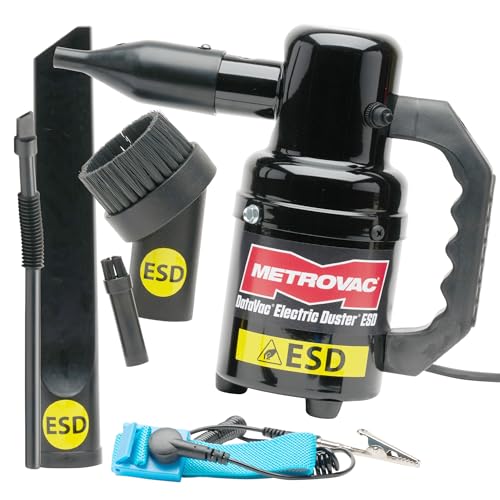
METROVAC ED-500-ESD PC Air Duster

piejus 130,000 RPM Cordless Electric Air Duster with 4-Gear Brushless Motor

seeclean 100,000 RPM Rechargeable Air Blower

YDNFE 280,000 RPM Air Duster

METROVAC MDV-1BA Computer Vacuum Duster
Why These Options Stand Out
A crowded desk or aging PC often needs more than a soft brush, and the METROVAC ED500 brings a reusable electric motor to those ordinary chores. I would expect it to suit a home office, garage, or workshop where the same blower handles keyboards, vents, appliances, and car interiors.
Compared with the later cordless models, this one stays tethered to an outlet, which may be preferable beside a fixed bench. The removable washable mesh filter also makes routine upkeep straightforward, though the exact cord length may determine how far the tool can travel.
A Strong Showing
- Strong airflow suits stubborn dust, pet hair, and particles around electronics.
- One tool can cover PC vents, keyboards, appliances, vehicle interiors, and household gaps.
- The reusable design removes the need to keep buying disposable air cans.
- Its compact, lightweight form should be easier to store than a full-sized shop vacuum.
Practical Considerations
- A nearby outlet is required, limiting use far from a stationary workstation.
- The broad versatility may make speed controls less important than on dedicated cordless models.
Key Specs
Who It Suits Best
PC owners who maintain several devices and also clean appliances, vehicles, and household crevices benefit most from this all-purpose approach.
A Better Fit Elsewhere
The piejus 130,000 RPM Cordless Electric Air Duster suits mobile repair kits and locations where a nearby outlet is inconvenient.
Static electricity is a sensible concern around exposed circuit boards, and the METROVAC ED-500-ESD addresses it with an antistatic system. The grounded three-conductor cord and wrist strap make this the most deliberately electronics-focused model in the lineup, especially for repair benches and IT work areas.
Unlike the more general ED500, this model includes a focused accessory set for narrow spaces. A 500-watt motor still handles keyboards, workstations, and general dust, while the steel body gives it a substantial feel that seems appropriate for frequent shop use.
Real Benefits
- ESD protection adds a practical layer of care during sensitive electronic work.
- The 500-watt motor provides useful force for debris lodged in ports and keyboard gaps.
- All-steel construction suits a permanent workshop or technician’s station.
- Crevice, brush, and micro-cleaning tools cover several kinds of confined spaces.
Small Caveats
- The wrist strap must be worn as part of the antistatic setup.
- Several accessories can become scattered during a busy repair session.
Feature Snapshot
Made For
Technicians, PC builders, and serious hobbyists working around exposed electronics benefit from the included grounding and precision accessories.
Where Another Pick Shines
The METROVAC ED500 Electric Duster fits general household cleaning better for people who do not need the ED-500-ESD wrist strap and grounding system.
A brushless motor and four airflow levels make this piejus model particularly useful for mixed electronics work. The gentle setting may suit delicate components, while higher levels can address keyboard debris, PC vents, and harder-to-reach dust without changing tools.
Compared with the METROVAC ED-500-ESD, this unit removes the power cord and adds two rechargeable batteries. At 5.39 by 3.7 inches and 0.49 pounds, it looks easy to place in a laptop bag, although the stated 120-minute maximum still depends on the selected speed and usage.
Real-World Strengths
- Four speed settings provide finer control than a fixed-output blower.
- Two 2,000mAh batteries offer useful cordless freedom for repair kits and travel.
- USB-C charging works with a laptop, car charger, or power bank.
- Four nozzles and ten brushes cover delicate internals, keyboards, vehicles, and household gaps.
- The battery indicator makes remaining charge easier to check between tasks.
Things To Consider
- The three-hour recharge time may interrupt a lengthy cleaning session.
- Maximum runtime occurs under the conditions stated for the device, so high-speed use may shorten it.
Right Fit For
Mobile PC repairers and compact-workbench operators gain the most from compact dimensions, four levels, and USB-C charging.
Consider Something Else When
The METROVAC ED-500-ESD PC Air Duster is a stronger fit for a stationary electronics bench where antistatic grounding is the priority.
Dark PC cases and cramped car interiors can hide dust that is hard to judge by sight alone, and the seeclean blower adds an LED light for those spaces. Three adjustable speeds let PC owners moderate the airflow while the cordless format keeps the tool away from wall outlets.
Unlike the piejus model with four gears and two batteries, this seeclean uses one 8,000mAh battery and three speed settings. Its display shows both remaining charge and the selected gear, which seems useful for a shared household tool, although the stated 20-to-40-minute operating period is much shorter.
Points In Its Favor
- Built-in LEDs illuminate dust inside dark cases and vehicle gaps.
- The display provides an immediate view of battery level and airflow setting.
- Three speeds accommodate delicate electronics and more stubborn debris.
- Five nozzles and three brushes cover keyboards, electronics, furniture, and inflatables.
Where It May Fall Short
- The tool cannot operate while charging.
- Its stated runtime is limited compared with longer low-speed endurance from other cordless choices.
Quick Facts
Best Suited To
PC owners working in dim areas or frequently cleaning car interiors appreciate the added lighting and visible operating status.
Reach For A Different Pick When
The YDNFE 280,000 RPM Air Duster suits longer cordless sessions that require an extended low-speed runtime.
High-output cleaning becomes more practical when a single tool also offers gentle modes, and the YDNFE provides three distinct operating levels. The 25,000-RPM mode handles sensitive surfaces, 60,000 RPM targets keyboard gaps, and the 280,000-RPM mode addresses stubborn debris in vents and filters.
Compared with the seeclean blower, this model claims 240 minutes in low mode but reaches a higher maximum speed. I would not treat the long runtime as representative of every setting, since the 5000mAh battery is paired with a roughly 3.5-hour charging time and a handheld design that favors portability.
Standout Benefits
- Three clearly separated speeds suit delicate components and stubborn buildup.
- A 120-watt turbocharging system supports the stated 280,000-RPM maximum.
- Low mode offers the longest stated operating time in the lineup.
- The room-temperature airflow avoids propellant condensation around electronics.
- A 0.65-pound body fits comfortably into a laptop bag or camera backpack.
Worth Noting
- The 240-minute figure applies to low-speed operation, not the maximum setting.
- A full initial charge is recommended before the first cleaning session.
Technical Highlights
The Right Fit
Traveling creators, PC builders, and field technicians benefit from selectable airflow and long low-speed endurance.
Swap It Out When
The piejus 130,000 RPM Cordless Electric Air Duster is a better fit for four precise speed levels and a smaller footprint.
Some computer cleanups work better when debris is collected rather than sent across the desk, and the METROVAC MDV-1BA combines vacuum and blower functions for that purpose. I see it as a practical choice for larger workstations, older computers with loose debris, and routine cleaning that includes keyboards, cases, and nearby equipment.
Unlike the ED500, this model can draw in fine particles, paper shreds, hair, and other debris before emptying its bag. Five replacement bags are included, although collection adds a disposal step that the hand-held blowers avoid entirely.
A Few Highlights
- Combines suction and blowing in one computer-cleaning system.
- Collects fine dust, hair, shreds, and larger debris instead of redistributing them.
- Five replacement bags support continued collection-based cleaning.
- Suits computers, accessories, peripherals, and general cleaning-and-repair tasks.
Possible Compromises
- The collection bag must be emptied and replaced during use.
- A suction-first workflow is less convenient for delicate internal parts than a narrow blower nozzle.
Whose Shelf It Belongs On
PC restoration enthusiasts and workshop operators who prefer to capture debris benefit from the combined vacuum and cleaner format.
Another Choice May Suit
The METROVAC ED-500-ESD PC Air Duster better serves repair work requiring a compact blower, precision attachments, and antistatic grounding.
What Matters in a PC-Cleaning Blower
Power Source and Setup
A corded blower offers continuous power and suits a permanent desk or repair bench. The METROVAC ED500 and ED-500-ESD follow that approach, while cordless models provide easier transport and faster access around a case.
Antistatic construction deserves attention for exposed components. A grounded cord and wrist strap add a deliberate protection step that a basic blower does not provide.
Air Control and Attachments
Adjustable speed helps distinguish delicate dust from stubborn debris. Four levels offer finer control, while three-speed models keep the controls simpler.
Attachments shape the practical result. Narrow tools suit ports and keyboard gaps, brushes handle surfaces, and LED lighting can reveal debris in dark spaces. The accessory count matters less than having the correct tip for the task.
Battery Life and Storage
Cordless freedom depends on more than motor speed. Runtime, recharge time, battery indicators, and USB-C charging affect daily use more directly.
Weight and dimensions also matter for a repair kit. A compact model can move between a laptop bag and a workbench, while a larger vacuum-based system may make more sense as a stationary addition.
Mistakes Worth Dodging in Electric Duster Purchases
Choosing solely by headline speed overlooks balance, attachments, and power source. A high-speed blower still needs an appropriate nozzle, and cordless convenience may matter more for a repair kit than maximum output.
Ignoring static protection can also narrow the decision too soon. PC repair work calls for attention to grounding, collection, and access rather than speed alone.
What Separates Premium From Basic
Higher-tier models add features such as multiple speed levels, antistatic grounding, LED illumination, or combined vacuuming. Those additions matter when one tool serves sensitive electronics, vehicles, and household debris.
A basic fixed-speed blower can remain the sensible choice for occasional cleaning near an outlet. The extra capability earns its place when a repair kit needs finer control or a cordless format.
Frequently Asked Questions
Can an electric duster replace canned air?
An electric duster can handle many routine dusting tasks without disposable propellant cans. The best fit depends on airflow control, attachments, and whether cordless portability matters.
Is antistatic protection important for a PC?
Antistatic protection is relevant during work around exposed circuit boards. The METROVAC ED-500-ESD includes a grounded cord and wrist strap for that type of repair setting.
Which cordless electric duster is easiest to carry?
The piejus model is the most compact option in this group, measuring 5.39 by 3.7 inches and weighing 0.49 pounds. The YDNFE offers longer low-speed runtime for extended sessions.
How many speed settings are enough for PC cleaning?
Two or three levels can cover delicate surfaces and stubborn debris. Four settings provide finer distinctions for mixed electronics, vehicles, and household cleaning.
Are METROVAC models suitable for computer cleaning?
All three METROVAC choices support computer cleaning, though their functions differ. The ED500 handles general air, the ED-500-ESD adds antistatic accessories, and the MDV-1BA collects debris with vacuum suction.
Final Verdict
I would choose the METROVAC ED-500-ESD for sensitive repair work, the piejus for portable precision cleaning, and the YDNFE for long cordless sessions. The METROVAC ED500 remains a practical general-purpose option, while the MDV-1BA stands apart when collecting debris matters more than blowing it away.
