
A live game session can look crisp on the monitor yet flat on a stream. I focus on six EMEET webcams that address common problems in gaming and streaming PC setups, from uneven facial lighting to limited framing and motion. Sensor size, autofocus, frame rate, and camera layout determine which model fits a particular workflow, while platform and lighting considerations matter just as much. These options range from a straightforward 4K webcam to dual-camera systems built for switching between wide and close views.
The Shortlist At A Glance

EMEET S600L 4K Webcam with Ring Light

EMEET C60E 4K PDAF Webcam
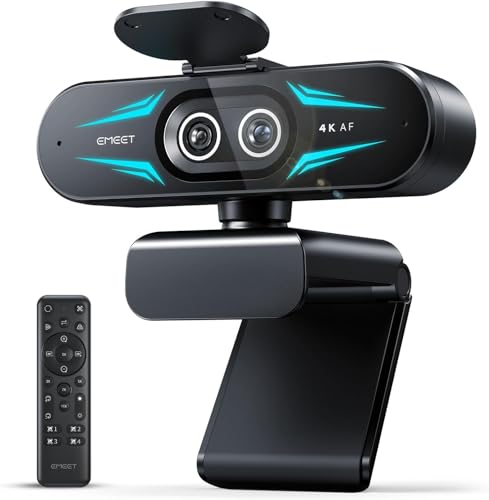
EMEET C60E Dual-Camera 4K Webcam with Zoom, Remote, RGB Lighting, 2 Mics

EMEET S600 4K Webcam, Sony Sensor

EMEET Piko Dual 4K Webcam

EMEET C960 Ultra 4K Metal Webcam
A Breakdown Of The Leading Choices
Flat facial lighting is an easy problem to overlook in a dim streaming room. The S600L addresses that setup gap with an integrated ring light and automatic exposure adjustment, giving me a reason to consider it for creators working without a separate key light.
Its 4K capture and 0.2-second phase-detection autofocus, or PDAF, also suit a gaming and streaming PC setup where subjects may shift position during a broadcast. Compared with the other EMEET models, this one puts lighting and imaging controls in a single package.
Real Benefits
- The integrated ring light reduces the need for a separate facial light.
- Automatic exposure adjustment helps maintain facial detail as room lighting changes.
- 4K resolution provides useful detail for close camera placement.
- PDAF focuses quickly enough for movement around a desk.
Worth Noting
- The ring light becomes another placement consideration near reflective monitors.
- Protection coverage depends on plan terms, so eligibility deserves checking before purchase.
Quick Facts
Made For
Streamers working in controlled rooms benefit from the combination of built-in lighting and 4K autofocus.
Consider Something Else When
The EMEET C60E 4K PDAF Webcam fits gaming creators who prefer a conventional 4K camera over an integrated ring light.
For a gaming stream, a simple camera that holds focus during rapid movement can matter more than a crowded feature set. The C60E combines a 1/2.8-inch CMOS sensor with 4K recording at 30 frames per second, giving the frame a practical balance of detail and motion.
Unlike the S600L, this model leaves lighting to the room or an external lamp. That makes it a more natural fit for a properly lit desk where another illuminated ring would not add much.
Features That Help
- The 1/2.8-inch CMOS sensor supports detailed 4K capture.
- PDAF maintains focus when a gamer leans or changes position.
- 4K at 30 frames per second suits many standard live broadcasts.
Small Caveats
- Room lighting needs attention, and the 4K mode is specified at 30 frames per second rather than a higher frame rate.
Right Fit For
Gamers and everyday streamers benefit most from the conventional 4K format and responsive focusing.
Look Elsewhere When
The EMEET S600 4K Webcam, Sony Sensor suits creators who want a documented 1080p option at 60 frames per second.
A single camera can struggle to show both a tabletop product and the creator handling it. This dual-camera C60E takes a different route, pairing a wide view with a telephoto view that can provide a closer composition for demonstrations.
Compared with the standard C60E, the added camera makes framing more flexible, while the remote, RGB lighting, and two microphones expand the control set. I see the greatest appeal in livestreams and online meetings where scene changes happen often.
Strong Points
- Wide and telephoto cameras support scene-level and close-up framing.
- The hybrid zoom reaches a stated maximum of 11x for tighter compositions.
- A remote simplifies camera and zoom adjustments during a broadcast.
- RGB lighting adds another tool for controlling the background and desk area.
- Two microphones reduce the need for separate audio capture.
Possible Compromises
- Two cameras and several controls make this setup more involved than a single-camera model.
- The telephoto camera is intended for use around 13.8 inches away.
- Hybrid zoom is not the same as a fully optical zoom, so close-up framing still depends on placement.
Feature Breakdown
Built With In Mind
Livestream producers and remote presenters benefit from switching between wide and close camera views.
A Better Fit Elsewhere
The EMEET Piko Dual 4K Webcam is a simpler recommendation for creators whose main requirement is dual-angle framing.
Resolution alone does not tell the whole camera story, and frame rate becomes just as important during fast gameplay. The S600 supports 4K at 30 frames per second or 1080p at 60 frames per second, giving creators a practical choice between fine detail and smoother motion.
Its Sony 1/2.55-inch sensor and PDAF make this a balanced middle ground. Compared with the larger-sensor C960, it asks for less of a specification leap while retaining useful framing controls.
Benefits That Matter
- The 1080p 60-frame mode supports movement-focused game streams.
- A 1/2.55-inch Sony sensor provides a useful foundation for 4K capture.
Points To Note
- The camera has no integrated light, so the surrounding room contributes more to the final image.
Technical Sheet
Who Should Grab It
Streamers balancing image detail with fluid movement benefit from the two documented capture modes.
Another Choice May Suit
The EMEET C960 Ultra 4K Metal Webcam better serves creators who prioritize a larger sensor and metal housing.
Showing a craft table and a creator’s face at the same time often produces an awkward compromise. The Piko uses a wide-angle camera for the surrounding scene and a telephoto camera for tighter shots, giving tutorials and product demonstrations two distinct compositions.
That dual-camera idea is the defining feature, not a decorative addition. Compared with the single-view S600, the Piko makes a stronger case for creators whose subjects change scale frequently.
Well-Handled Touches
- The wide camera keeps a creator and surrounding workspace in view.
- The telephoto camera supports close views of hands, products, and facial details.
- 4K capture gives both camera perspectives a high-resolution foundation.
Practical Considerations
- Close-view framing still depends on accurate camera placement.
- A separate light remains relevant because the integrated lighting benefits are not specified.
The Right Fit
Tutorial creators, instructors, and product presenters benefit from switching between environmental and close compositions.
Reach For A Different Pick When
The EMEET C60E Dual-Camera 4K Webcam with Zoom, Remote, RGB Lighting, 2 Mics suits creators wanting added zoom, lighting, and audio controls.
A desk-mounted camera intended for regular use can justify a more deliberate physical design. The C960 combines a metal body with a large 1/1.5-inch sensor, a larger physical format than the sensors used by the other models listed here.
Its 4K output, 0.2-second autofocus, and stated Mac and PC compatibility make it a serious fixed-setup option. The honest read is that careful lighting still matters, but the hardware is aimed at creators who want a substantial sensor foundation.
Bright Spots
- The 1/1.5-inch sensor provides a larger imaging surface.
- A metal body suits a permanent desktop arrangement.
- 0.2-second autofocus responds quickly to subject movement.
- 4K capture supports detailed presentation and tutorial footage.
Factors To Consider
- A larger sensor does not remove the need for appropriate room lighting.
- The stated device compatibility covers Mac and PC rather than every possible platform.
- Mounting hardware and desk clearance deserve checking before installation.
Feature Facts
Whose Shelf It Belongs On
Professional creators working from a permanent Mac or PC desk setup benefit from the larger sensor and metal construction.
Where A Sibling Pick Shines
The EMEET S600L 4K Webcam with Ring Light better suits a dim room where built-in facial lighting takes priority over sensor size.
What Matters In A Streaming Webcam
Sensor Size And Focus Behavior
A larger sensor can gather more light than a smaller one, giving creators more room for detail and tonal range. I pay attention to the stated sensor size, but lighting remains part of the equation. PDAF, meaning phase-detection autofocus, also matters for gaming because it adjusts focus as the subject moves closer or farther away.
Resolution And Frame Rate
4K provides four times the pixel count of 1080p, but the frame rate changes the character of the footage. The S600 supports 4K at 30 frames per second and 1080p at 60, a practical distinction for creators balancing detail against smoother motion. For a talking-head stream, 30 frames per second may be sufficient, while rapid game action makes the higher frame-rate mode worth considering.
Lighting And Camera Placement
The S600L stands apart with its integrated ring light and automatic exposure adjustment. Other models depend more heavily on the room, which can be an advantage in a properly lit studio. Camera distance also changes the result, especially with a telephoto view, so the 13.8-inch recommendation for the C60E dual-camera model deserves attention during setup.
Setup Complexity And Platform Fit
Single-camera models create the simplest workflow, while dual-camera arrangements support wider scene changes. I also check the physical desk arrangement, since a metal housing and telephoto camera can demand more clearance than a compact single webcam. The C960 is explicitly listed for Mac and PC, so confirming platform fit comes before the final choice.
Two Checks Before Camera Setup
Common Shopping Slip Ups
I would avoid choosing from resolution alone, since sensor size, autofocus, frame rate, and lighting determine how footage feels. A dual-camera model can also feel more complicated than a single camera, making remote adjustment and placement worth considering before setup.
What Separates Premium From Basic
The higher-tier models add larger sensors, metal construction, dual cameras, remote controls, lighting, or integrated microphones. Those additions matter most for creators who regularly change framing, work in a fixed studio, or need a more capable image without assembling separate accessories.
Frequently Asked Questions
Do These Webcams Work With A Gaming And Streaming PC?
These are external webcam options intended for computer-based streaming and gaming setups. The C960 is explicitly listed for both Mac and PC, while the remaining models are positioned around streaming and gaming use.
Is 4K Better Than 1080p For Streaming?
4K captures more detail, but 1080p at 60 frames per second can produce smoother motion. I would favor 4K for close detail and 1080p at 60 frames per second for fast-paced gameplay where fluid movement matters more.
Which Model Includes A Ring Light?
The EMEET S600L 4K Webcam with Ring Light is the model with integrated illumination. It also adjusts exposure as the lighting changes, making it a practical choice for a dim streaming area.
What Is The Advantage Of A Dual-Camera Webcam?
A dual-camera design provides wide and telephoto perspectives within one setup. That combination helps with product demonstrations, tutorials, and streams that shift between the surrounding scene and a closer subject.
Does Autofocus Matter For Gaming Streams?
Autofocus matters when a creator leans forward, stands, or moves closer to the camera. The listed PDAF models adjust focus as subject distance changes, reducing the need for manual focus adjustments during movement.
Wrap Up
The best gaming and streaming PC webcam depends on the production problem, not on resolution alone. I favor the S600 for flexible frame rates, the S600L for built-in lighting, the C60E dual-camera model for active scene changes, and the C960 for a larger sensor and substantial desk setup. The Piko covers the core dual-angle need with a more focused feature set.
